
Cinema has given us plenty of heroes, but the ones that truly haunt us are the movies where the villain wins, and the audience is left carrying the discomfort home. These films stay with us long after the credits roll, leaving us uncomfortable, emotionally overwhelmed, and unsettled since they don’t provide solace, closure, or happy endings.
A couple of months ago, on a quiet Sunday evening, I decided to re-watch David Fincher’s Se7en. My father, who is not much of a movie person, happened to visit me and sat down to watch the movie with me. To my surprise, he was completely absorbed by it from start to finish, by its grim atmosphere, the tension, and even the gore, which didn’t push him away. But then came the ending.
The moment the film revealed that the villain had won, he just sat there disappointed. Not because the film was bad, but because the villain won in the end. He said there are already enough bad people in the real world getting away with horrible things without consequences, and that’s depressing as hell. “I want to watch movies to escape that feeling, not be reminded of it,” he said before quietly leaving the room.
And that gave me the idea to explore movies where the bad guys win. The title of this list uses the word “unforgettable” for a reason, as these films do far more than shock the audience. They explore the deepest and darkest facets of human nature in ways that continue to haunt your thoughts long after the movie is over.
This list is not limited to one genre either. It moves through political thrillers, neo-noir mysteries, psychological horror, folk horror, westerns, crime dramas, and more. Alongside widely celebrated masterpieces, you will also find overlooked gems, cult favorites, and newer films that deserve far more attention than they get.
So without further ado, here are 25 unforgettable movies where the villain wins.
25. Coming Home in the Dark (2021) – James Ashcroft

Coming Home in the Dark, directed by James Ashcroft, is a visceral, nerve-shredding New Zealand psychological thriller and the kind of film that lets you know right away this list isn’t here to comfort you—a perfect opening entry for movies where the villains win.
During a seemingly peaceful family road trip, high school teacher Alan “Hoaggie” Hoaganraad (Erik Thomson), his wife Jill (Miriama McDowell), and their two stepsons encounter two soft-spoken but psychotic drifters, Mandrake (Daniel Gillies) and Tubs (Matthias Luafutu). The two men lead the family on a terrifying and violent journey, ultimately forcing Alan to confront a brutal act from the past.
Coming Home in the Dark benefits from James Ashcroft’s confident direction and the use of New Zealand’s rugged environment to increase the sense of isolation and doom. The film seems at first to be a generic sadistic thriller, but as it develops, more layers are revealed, and you realize it is not your average thriller but a story of buried guilt, child abuse, and institutional cruelty that has left permanent scars. The villain succeeds here because he forces the protagonist to confront his past sins of complicity and ignorance, and in doing so, he destroys the protagonist’s life while exposing the hypocrisy and moral cowardice he has spent years hiding from.
As a result, long before the film reaches its conclusion, the villain has already dismantled the family both psychologically and emotionally. What lingers after the credits is the film’s bleak understanding that revenge changes nothing. The villain can punish, expose, and destroy, but none of it can undo the trauma buried underneath it all. The scars remain, stubborn and permanent. Available for free on Tubi.
24. Kill List (2011) – Ben Wheatley

Trust in Ben Wheatley to take a familiar premise and take it somewhere deeply strange and unnerving. Kill List is a brutal, genuinely unsettling, and savage British horror thriller that makes an ideal fit for this list.
Nearly a year after a botched job, a hitman, Jay (Neil Maskell), with a temper and a rocky marriage due to money problems, gets persuaded by his partner, Gal (Michael Smiley), to get back to work and take a new assignment with the promise of a big score for three killings. What begins as a simple mission soon unravels, plunging the hitman into the depths of darkness.
The film moves smoothly from dark comedy/family drama in the first act to a crime thriller in the second, before descending into full-blown folk horror in the third. The genre-bending makes the plot unpredictable and keeps us on our toes. I must confess the dive into folk horror was very unexpected, as was the revelation of who the dark cult is. Here, the villains fully carry out their ritualistic grand plan, manipulating Jay from the very beginning without his knowledge. The villains use Jay as a pawn to complete the satanic ritual, orchestrating his downfall, leaving him broken and traumatized as his family for the rest of his life.
The cruel genius of the screenplay is that Jay never really had a fighting chance. By the time he realizes something is wrong, the trap has already closed around him. He’s been quietly molded toward his own destruction from the very beginning, psychologically hollowed out long before the finale arrives. That slow realization is what makes the film so deeply disturbing. You can watch Kill List on Shudder.
23. Eden Lake (2008) – James Watkins

James Watkins’ Eden Lake is a harrowing, brutally effective, and highly disturbing dark thriller movie that turns an ordinary getaway into a horrifying representation of social degradation and unrestrained cruelty.
The film follows Steve (Michael Fassbender) and Jenny (Kelly Reilly) as they travel to a remote, picturesque lake for a romantic weekend. A bunch of young, aggressive adults, led by Brett (Jack O’Connell), start pestering them. The harassment quickly turns violent and rageful as the group ruthlessly terrorizes the couple in inconceivable ways, turning an ordinary weekend getaway into a deadly battle for survival.
The escalation of violence and brutality in this film is brilliantly controlled, as the gang’s actions, especially Brett’s, become increasingly barbaric and unimaginable. What’s more upsetting is that the film lacks any catharsis, so no matter how much you want Jenny and Steve to escape and Brett to die for his heinous actions, it doesn’t happen. The film is devoid of any justice, morality, or escape. And this is where the villain, i.e., Brett, wins. He gets away unscathed and without facing any consequences, leaving Jenny broken, devastated, and completely powerless because there is no way out.
You may also wonder what has caused Brett to become so desensitized and dehumanizing, and the answer is his environment, his upbringing, in which violence, intimidation, and emotional neglect are normalized. The film delves into themes of untamed youth, class division, and a society devoid of compassion and innocence, in which brutality and cruelty are the only acceptable standards. Here, the evil is young, plentiful, and unstoppable. Available for free on Tubi.
22. Calibre (2018) – Matt Palmer

Matt Palmer’s Calibre is a sensationally well-executed, morally devastating, and nerve-racking psychological thriller and one of the few Netflix Originals that I’ve enjoyed.
Marcus (Martin McCann) and soon-to-be father Vaughn (Jack Lowden) set out on a hunting trip to a remote Highland village, only for it to spiral into a relentless nightmare after they attempt to cover up a horrific accident. As paranoia mounts, the two men find themselves trapped in a suffocating web of suspicion woven by the village’s tight-knit and constantly watchful community.
The beauty of the film is how casually it slides from “weekend hunting getaway” into full-blown psychological nightmare territory. Before long, Marcus and Vaughn are trapped in the village within a volatile, insular local community, which is loyal, conservative, and filled with grief and rage. Once the locals discover what Marcus and Vaughn have done (accidentally killing a local during hunting), they quickly tighten their grip on the situation, leaving the protagonists cornered. They not only get even with Marcus and Vaughn’s actions but also leave permanent psychological scars and get away with it by burying the truth.
However, more than the villagers, the true villain is the consequence of the protagonists’ own actions. And instead of stepping forward and confessing that Marcus accidentally killed the local, they attempt to hide the event in every possible way, demonstrating human frailty and remorse, resulting in additional violence, moral compromise, and long-lasting damage from their bad choices. Additionally, the makers maintain the hostile atmosphere, trapping Marcus and Vaughn in a small village filled with unpredictable characters from which there appears to be no escape. In the end, evil not only triumphs but also condemns the “survivor” to a hellish existence. Available on Netflix.
21. Anguish (1987) – Bigas Luna

Anguish, directed by Bigas Luna, is a completely bonkers, deeply unnerving, and brilliantly inventive meta-horror film that ended up being one of my most unexpected discoveries while putting this list together.
The film operates through a deliciously twisted film-within-a-film setup. In the fictional movie The Mommy, a timid optometrist’s assistant, John Pressman (Michael Lerner), under the suffocating psychological control of his telepathic mother Alice (Zelda Rubinstein), embarks on a grotesque killing spree centered around the collection of human eyeballs. As the audience sits and watches this nightmare unfold on screen, the horror starts to leak into the real theatre, turning a normal movie night into total anarchy.
Bigas Luna directs with expert skill, blending fiction and reality with consummate aplomb. Stylish camerawork and smooth editing add to the claustrophobic, inescapable dread. The terrifying mother has complete psychological control of her son and uses him to realize her twisted goal. The cinematic terror from within the film spills over into the real world as the real-world killer, mentally unstable and with mommy issues, begins killing in the theater. By the end, the audience is trapped in the nightmare, unable to escape as the violence becomes repetitive, symbolic, and psychologically contagious. Alice, the villain, wins because she dominates and transforms a human being into a tool of terror. She doesn’t just win inside the film; her influence, monstrous control, and cinematic violence spill into the real world itself. Anguish is an experimental, distinctive, and unforgettable horror film where evil wins, making it a perfect fit for the list of movies where the villain wins. Available to stream on Amazon Prime Video.
20. Arlington Road (1999) – Mark Pellington

Mark Pellington’s Arlington Road cleverly fuses paranoid conspiracy cinema with Alfred Hitchcock’s Rear Window (1954) inspired “killer next door,” resulting in a gripping thriller that still feels uncomfortably relevant in its exploration of America’s fear of domestic terrorism.
Jeff Bridges plays Michael Faraday, a college professor who teaches about extremism and domestic terrorism while still grieving the death of his wife (who worked in the FBI) in a botched FBI operation. Upon meeting his new neighbors, Oliver (Tim Robbins) and Cheryl Lang (Joan Cusack), he begins to suspect and grows increasingly paranoid that they are not who they claim to be. As he investigates Oliver further, he discovers who they really are and a deadly conspiracy plot with disastrous consequences.
With unorthodox camera angles, sharp editing, and dark, moody lighting, the film slowly ensnares Michael in a world that feels increasingly paranoid and unstable, where suburban normalcy starts to conceal something sinister just beneath the surface. What begins as a paranoid suspicion (one that might be justified, as Michael’s wife died as an FBI agent and he teaches about domestic terrorism), becomes something dangerous and terrifyingly calculated.
The villains win because they choose the perfect scapegoat in Michael, whose troubled past conveniently fits the narrative they want to construct. More importantly, they understand far better than the protagonist how systems manipulate fear, control information, and shape public opinion. What makes the film so diabolical is that the villains not only plan and execute the crime flawlessly, but also manipulate every aspect of the aftermath to ensure they walk away completely scot-free.
On the other hand, the more Michael fights back, the more he falls into the carefully crafted trap of deception and systematic exploitation. By the end, no justice or redemption awaits him, only destruction. Here, evil proves far smarter than anyone anticipates, allowing the villain to get away with a horrifying act and leaving a bleak ending that strongly suggests he will continue his actions. Available for free on Tubi.
19. Primal Fear (1996) – Gregory Hoblit
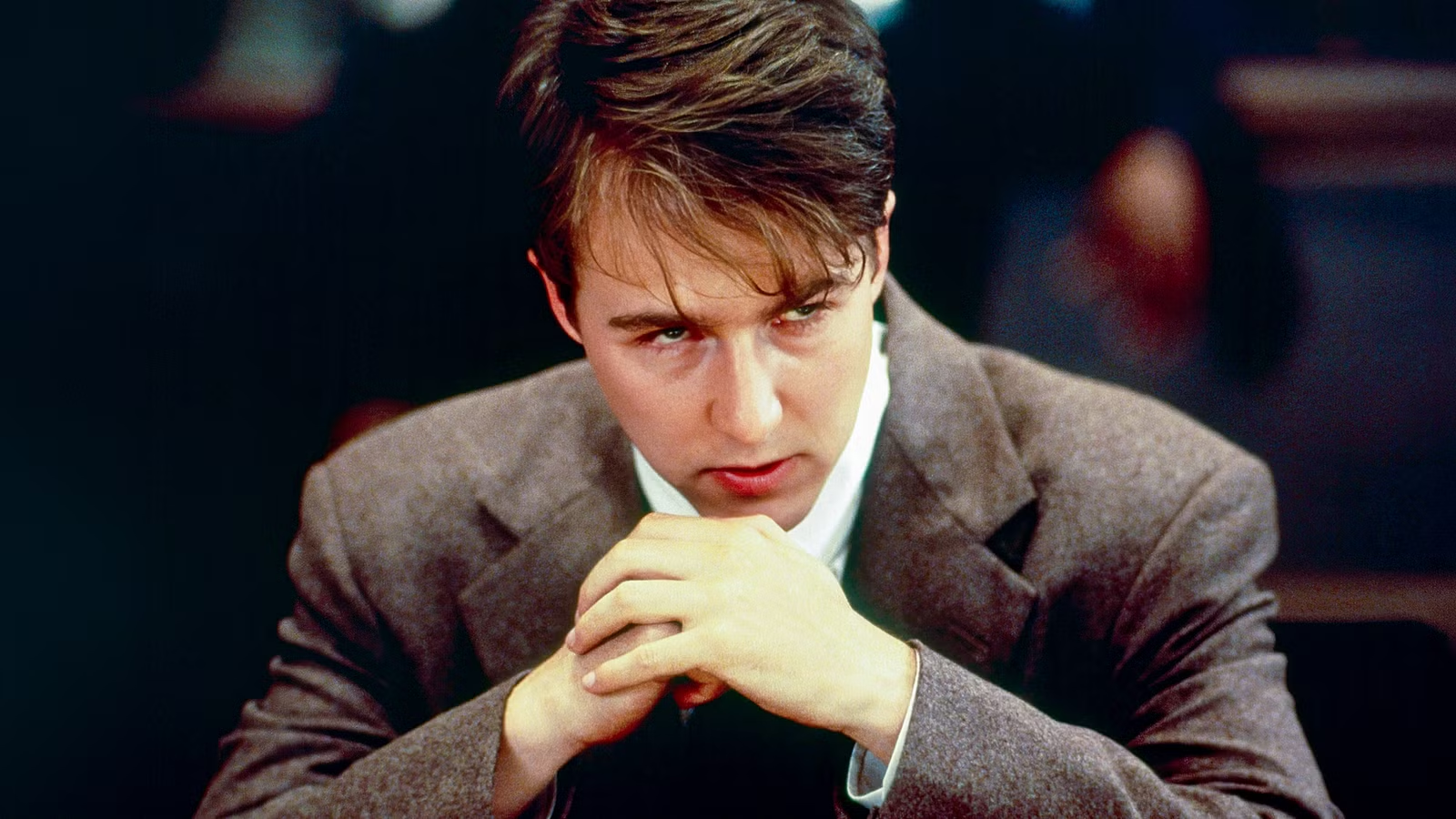
Gregory Hoblit’s riveting courtroom thriller Primal Fear delivers a shocking climactic plot twist, right up there with The Usual Suspects (1995) and The Sixth Sense (1999) in terms of shock value – we don’t see it coming.
The film follows Martin Vail (Richard Gere), a hotshot Chicago lawyer who takes on the high-profile case of Aaron Stampler (Edward Norton), a shy, stuttering altar boy accused of murdering a Catholic archbishop. In defending Aaron’s innocence, the case starts unearthing the church’s hidden truths, devolving into a complex tapestry of abuse, corruption, and psychological deceit.
In Primal Fear, we see what happens when evil is intelligent, charming, and manipulative. The villain goes to great lengths to create a whole false persona, presenting himself as vulnerable and harmless to gain sympathy. He creates a character so believable that the thought of him committing such crimes seems almost impossible. However, he turns out to be a cold, calculating psychopath who fools everyone around him, including the justice system, the lawyers, and even the audience. By the time the people around him realize what has really happened, it is already too late, and the people who bought his act are humiliated, questioning their judgment and losing faith in their own instincts. In this case, evil wins through superior intellect and performance, leaving cynicism in its wake. Available on Netflix.
18. The Gift (2015) – Joel Edgerton

The Gift is the confident directorial debut by Joel Edgerton, a smart, subversive psychological thriller that delves into bullying, revenge, and the tenuousness of control.
Simon Callum (Jason Bateman) is a successful businessman who, along with his family, moves into a new suburban home. While shopping, they meet Simon’s high school friend, Gordon (Edgerton), who is friendly and makes a good first impression. As their relationship develops, it gradually takes a dark turn, revealing long-buried secrets and growing animosity between them.
The real star here is Edgerton’s script, which generates intrigue and heightens suspense and anticipation as the film unfolds. The Gift is a perfectly executed tit for tat revenge film. The villain succeeds by inflicting the same psychological and emotional revenge that he felt when he was younger. The protagonist, who was once a bully, ruins the antagonist’s life during their younger years by spreading a vicious rumor that poisons people’s minds with thoughts about him, leaving behind deep psychological and emotional scars that continue to linger.
As a result, years later, the antagonist gradually and methodically dismantles the protagonist’s perfect life, from marriage to career to reputation to sense of control, but not before instilling a poisonous idea in the protagonist’s mind about the father of his new child, leaving the protagonist broken and paranoid. Here, the villain wins a psychological victory without ever using physical violence, forcing the hero to confront his own monstrosity and permanently destroying his peace of mind. Evil here is patient, intelligent, and deeply personal. Available on Amazon Prime Video.
17. The Killing of a Sacred Deer (2017) – Yorgos Lanthimos

There are a few directors who operate on the same weird wavelength as Yorgos Lanthimos, and The Killing of a Sacred Deer is living proof of that. Equally bizarre, clinical, and horrifying, the film sinks its claws into you slowly until the discomfort becomes impossible to shake off.
The film follows Dr. Steven Murphy (Colin Farrell), a renowned cardiovascular surgeon who leads a life of affluence with his wife Anna (Nicole Kidman) and their two children. He makes friends with Martin (Barry Keoghan), a young, awkward man who is the son of a man who died on Steven’s operating table. At first, Martin is friendly to the whole family, especially to his daughter Kim, who takes a liking to him. But his presence in their lives slowly tears the family apart, and unleashes a supernatural curse, forcing Steven to make a moral sacrifice to save his loved ones.
Lanthimos, like Michael Haneke in Funny Games, directs with chilly detachment and clinical precision, using wide angles, long takes, minimalist dialogue, and a haunting score to create a constant state of tension and discomfort. What makes the villain so unsettling is that, in his own mind, he’s not acting out of chaos but out of balance. He deals with his father’s death with a chilling calmness, a terrifying clarity, and a twisted sense of justice that makes his actions feel coldly inevitable rather than impulsive. He befriends Steven at first, gets close to his family, only to then suddenly and casually present Steven with a difficult moral equation: to avenge his father’s death, Steven must kill one member of his own family or lose his entire family. And then, all of a sudden, both of his children become paralyzed in their legs, and no doctor can figure out why, putting Steven in a difficult position since it undermines his confidence, influence, and humanity.
Steve tries every possible logical solution, but eventually finds himself forced to make a decision that tears his family apart and leaves them emotionally shattered. Here, the antagonist doesn’t win through brute force but through moral and psychological entrapment, forcing the protagonist to become the architect of his own destruction. The Killing of a Sacred Deer is another great addition to the list of movies where the villain wins. Available on Amazon Prime Video.
16. Angel Heart (1987) – Alan Parker

Alan Parker’s Angel Heart is an atmospheric, hypnotic, diabolical treat that keeps you intrigued at every turn and has deservedly become a cult classic over the years.
Set in 1950s New York, the film follows a mysterious man named Louis Cyphre (Robert De Niro), who hires down-on-his-luck private investigator Harry Angel (Mickey Rourke) to track down a 1940s crooner named Johnny, who disappeared after owing Cyphre a debt. As a result, Harry embarks on a journey that takes him from frigid Harlem to sweaty New Orleans, where he becomes entangled in voodoo magic, ritualistic killings, and his own long-forgotten history.
Angel Heart is a strong genre mash-up that transitions from neo noir to psychological thriller to supernatural horror with expert precision. The film travels from frigid Harlem to sultry, sticky New Orleans, immersing viewers into a sweaty sensation of dread and a murky domain of dark arts, black magic, and ritualistic homicides. In the end, the villain gets exactly what he wants by claiming Johnny’s soul. What makes it even more disturbing is that he achieves it through a carefully orchestrated long con, manipulating Harry into confronting a horrifying truth he has spent years repressing or subconsciously avoiding. This leads Harry to the realization that he is somehow involved in all the murders surrounding the very case he is investigating.
By the time Harry understands who he really is, it is already too late, because his fate was sealed long before the investigation even began. The protagonist’s tragic fate, predetermined from the start by the villain’s psychological and spiritual shackles, provides for an unsettling viewing experience. Available for free on Tubi.
15. Funny Games (1997) – Michael Haneke

Michael Haneke’s Funny Games creates a merciless, unpleasant viewing experience that mocks the audience’s notions of morality, catharsis, and cinematic justice.
Two soft-spoken but psychopathic young men, Peter (Arno Frisch) and Paul (Frank Giering), invade a vacation cottage occupied by a wealthy family consisting of father Georg (Ulrich Muhe), mother Anna (Susanne Lothar), and their son, and force them to play sadistic “games” with each other for their own amusement.
The film is a scathing critique of media violence and how human beings have been dehumanized and acclimated to it. Michael Haneke generates unbearable tension through long takes and wide-angle shots that highlight the cold, clinical way in which the entire atrocity unfolds. The film is bleak and hopeless throughout; there is no sense of justice, retribution, or escape as the villain gains total dominance and narrative control. Just because people commit evil deeds does not mean they will experience bad consequences. Karma does not exist in Haneke’s films.
Even as the protagonists fight back and try to regain some sense of agency, Michael Haneke strips it away with his infamous rewind scene, making it painfully clear that they never truly stood a chance and deepening the despair of their situation. As a result, the villains win by destroying the family in a brutal and sadistic fashion, employing excessive violence, and doing it in a very casual and playful manner, with no consequences whatsoever, before moving on to their next victims. Funny Games is easily one of the best movies with bleak endings.
14. The Wicker Man (1973) – Robin Hardy

I love films where someone arrives in a new place and slowly realizes the vibes are catastrophically off, and that nothing is quite what it seems. Robin Hardy’s The Wicker Man belongs in that category and is one of my favorite folk horror films of all time.
The film takes place on the secluded Scottish island of Summerisle, where a pious Christian police sergeant named Neil Howie (Edward Woodward) arrives to investigate the abduction of a little girl. Soon, he finds that the islanders are not very cooperative and are performing strange fertility rituals and Celtic paganism under the leadership of Lord Summerisle (Christopher Lee). The more he investigates, the more he gets caught up in a well-planned web of lies, superstitions, and barbaric rites.
The film begins as a police procedural, with Sergeant Howie arriving on a remote island to investigate the disappearance of a small child, but soon turns into an ominous folk horror story exploring blind faith, superstition, herd mentality, and manipulation. Gradually, Howie learns that the whole community follows a form of Celtic paganism based on strange rituals and disturbing beliefs. The villains achieve a complete ritualistic win, manipulating the protagonist’s investigation, leading him astray at every turn, and controlling his every move from the get-go.
Under the charismatic leadership of Lord Summerisle, the villagers believe an occult ceremony is necessary to appease their pagan gods and restore the failing apple harvest that has blighted their island. So in the terrifying final scene, the villagers take full control, achieve their goal, and celebrate their victory. The movie mocks faith and authority, and paganism wins big time. Their victory is rooted in communal ideological hegemony, with the entire village united under a single belief system. As a result, the hero’s struggles and resistance are in vain, ultimately turning him into the perfect sacrificial lamb. The Wicker Man is one of the most satisfying (and terrifying) horror movies where the villain wins. Available to rent on Amazon Prime Video.
13. Hereditary (2018) – Ari Aster

Still, his best work to date and a defining example of modern elevated horror, Hereditary, directed by the talented Ari Aster in his feature directorial debut, is notable for its creative direction, deep psychological and emotional impact, thematic depth, and simmering tension rather than a reliance on cheap jump scares.
After the death of the family matriarch, Annie Graham (Toni Collette) struggles with grief alongside her husband, Steve (Gabriel Byrne), and two children. Over time, the family begins to experience unsettling occurrences, scary visions, and the revelation of long-buried truths, all pointing to a terrifying supernatural plot involving their lineage.
At first, I thought Hereditary was just another possession movie, a concept that has been done to death in the horror genre. But it turned out to be more than that, with its thematic complexity and a supernatural conspiracy keeping me hooked throughout. Here, the villain uses the Graham family’s grief, trauma, blood links, and emotional fractures to gradually erode their identity and turn them into instruments for a larger design. I would not be surprised at all if Ari Aster drew heavy inspiration from Rosemary’s Baby when making Hereditary. Both films center around cults that operate in the shadows, manipulating a family from within without the family ever truly realizing it. And in both films, the scariest part is that evil doesn’t just survive at the end, it gets exactly what it wanted.
The film is disturbing for many reasons, not the least of which is the feeling that the Grahams were doomed from the very beginning; they never really had a chance to escape or fight back, because evil had already dug its claws deep into the family, controlling their destiny. As a result, Hereditary represents predestined human manipulation in which evil triumphs completely, leaving no hope, only horror. Available on Netflix.
Read Next: If you appreciate cinema that challenges traditional genre boundaries, check out our breakdown of More Than Action: Kung Fu Movies Beyond Fighting
12. Blow Out (1980) – Brian de Palma

Blow Out, Brian de Palma’s chic neo-noir conspiracy thriller, is like a cross between Francis Ford Coppola’s The Conversation(1974) and Michelangelo Antonioni’s Blowup (1966).
While recording sounds for a slasher film, Jack Terry (John Travolta), a sound effects technician, witnesses and records a real-life car accident in which the person turns out to be the governor, who is intending to run for president. As he listens closer to the recording, he realizes he’s stumbled into a terrifying assassination plot and contains evidence of the killing. Now his life is at risk as a merciless operative, Burke (John Lithgow), is sent to tie up loose ends.
When the perpetrators higher up the order learn that Jack has a critical piece of information that could expose them, they send a deadly political fixer after him to eliminate all traces of the conspiracy. In this case, the villains, the corrupt political forces, win by hiding the truth and taking innocent lives, rendering Jack’s heroic efforts meaningless and leaving him completely powerless and broken in the end. The film ends on a dismal and nihilistic note, implying that in a corrupt system, the powerful and crooked almost always win, leaving commoners with nothing to do but watch helplessly as justice remains elusive.
11. Nightcrawler (2014) – Dan Gilroy

Jake Gyllenhaal delivers what is still arguably the best performance of his career in Dan Gilroy’s slick and relentless Los Angeles neo-noir thriller, turning ambition itself into something genuinely terrifying.
The film follows Lou Bloom (Jake Gyllenhaal), a sociopath looking for work who stumbles into the world of LA “nightcrawling”—racing to crime scenes with a police scanner and camera in hand to sell gruesome footage to local TV stations. He becomes engrossed in the profession and slowly rises through the ranks by teaming up with a desperate news director, Nina (Rene Russo), and breaking every ethical, moral, and legal tenet of journalism.
The film is an excellent character study of Louis Bloom, a man who uses ambition, charm, and sociopathy to pursue the American Dream with no moral boundaries. He is not a rule-breaker who acts like a rebel, but rather someone who understands and effectively exploits the rules. He is a very ambitious person who starts as a sore loser and petty thief, showing some clear sociopathic tendencies in his personality. What starts as subtle hints of sociopathic behavior slowly solidifies into a full-blown sociopathic mindset, with ambition being the only driving force behind his actions, unaffected by morality and remorse.
The deeper he gets into the world of nightcrawling, the more he will stop at nothing to survive and prosper, even if it means manipulating crime scenes, blackmailing top executives of media channels, withholding information, orchestrating events for better footage, or sacrificing his partner for personal gain. But the more troubling aspect here is that the system endorses him and his actions. His victory is the systematic sanctioning of evil in a morally bankrupt capitalist society, suggesting that sociopathy and moral corruption are not just rewarded but are often the only ways to rise, succeed, and dominate. Evil here doesn’t just win; it is promoted and thrives. Available for free on Tubi.
10. Gone Girl (2014) – David Fincher

In today’s social media-dominated world, the one who controls the narrative controls everything. And this is precisely what David Fincher’s Gone Girl explores in this sleek, icy, and extremely cynical adaptation of Gillian Flynn’s best-selling novel of the same name.
On their 15th wedding anniversary, Nick Dunne (Ben Affleck) returns home to discover his wife, Amy Dunne (Rosamund Pike), missing. The police launch an investigation, and the case quickly becomes a media circus. But as the investigation progresses, dark secrets and psychological games in their marriage come to light, and it turns out all is not as it seems.
Fincher takes his time in the beginning to flesh out Amy Dunne’s character and the evolution of her relationship with Nick. She has a keen understanding of human nature and the social systems surrounding it, knowing precisely how people are valued, manipulated, and defined by wealth, relationships, and public opinion. With all this in mind, she rewrites her own story by crafting a plausible victim narrative, and deceives the police, the media, and public opinion. And what makes her even more devilish and cunning is that even when things don’t go as planned (even though her planning is nothing short of flawless), she improvises, uses people, kills them, and does everything she can to win people’s favor.
In the end, the villain succeeds because, in the aftermath of it all, even though we know their true character and what she is capable of, they win due to narrative supremacy, and protagonist is trapped and helpless due on fear and perception. Here, the villain wins not by overwhelming anyone, but by dominating the game of perception so thoroughly that the reality becomes meaningless in the end. Available on Netflix, Prime Video, or Disney+.
9. The Usual Suspects (1995) – Bryan Singer

The Usual Suspects, directed by Bryan Singer and written by Christopher McQuarrie, is a masterclass in screenplay writing, featuring razor-sharp dialogue, an unexpected narrator, and one of cinema’s greatest twists.
After a deadly heist goes wrong on a ship in San Pedro Bay, the lone survivor, Verbal Kint (Kevin Spacey), recounts the story to Detective David Kujan (Chazz Palminteri), explaining how five criminals who first met during a police lineup (and are assigned for the heist job) become gradually entangled with the mythical and terrifying crime lord Keyser Söze.
The entire film operates like one giant sleight of hand, with the screenplay manipulating the audience so effortlessly that by the end, you almost admire how completely it fooled you. Here, the villain wins solely via intellectual dominance. He constructs a narrative and shapes the police officers’ perceptions in real time, presenting a plausible story that everyone gobbles up because it is cohesive, detailed, and emotionally persuasive. By the time doubts arise, the villain is “poof!” gone forever. He manipulates the story and reshapes the narrative so cleverly that the truth no longer matters. In the end, the villain has made the protagonists and the audience unwitting pawns in pulling off the greatest trick of convincing the world that the devil does not exist. Evil here is smart, invisible, and forever triumphant.
8. The Vanishing (1988) – George Sluizer

The Vanishing, directed by George Sluizer, is a chilling journey into the mind of a serial killer as well as the psychological unravelling of its protagonist, making it one of the most disturbing psychological thrillers ever made.
While vacationing in France, young couple Rex (Gene Bervoets) and Saskia (Johanna ter Steege) stop at a crowded service station, where someone kidnaps Saskia in broad daylight. Three years have passed, but Rex still has no answers or closure regarding the fate of his girlfriend. However, he begins to receive letters and eventually meets the abductor, Raymond (Bernard-Pierre Donnadieu), a family guy and a mild-mannered chemistry teacher who keeps a dark secret and is the only person who knows what happened to Saskia that fatal night.
The film uses an interesting narrative structure in which the screenplay reveals nearly everything the audience wants to know without relying on conventional twists and turns, yet still maintains the kind of unnerving suspense and psychological dread that Alfred Hitchcock himself would likely have admired. What’s terrifying is that Sluizer strips away the sensationalism and shock value and replaces it with normalcy and realism, reminding us that the banality of evil is far scarier than any masked killer or otherworldly force could ever be. The villain is ominous and menacing not only because he acts with cold rationality, meticulous planning, and appears to be the most ordinary man you’ll ever meet, but also because of his cold curiosity and an unsettling desire to test his own capacity for evil.
Thus, the villain wins completely by committing whatever crimes he wants and getting away with it with relative ease. Not only does he not suffer and is devoid of conscience, but he also makes the protagonist’s life a living hell by toying with him his fixation for closure to force him to endure a fate far worse than death. The Vanishing is a symbol of ultimate existential manipulation, with the villain using the human desire for resolution and meaning to trap the protagonist in a skillfully crafted psychological hell from which there is no escape. Streaming on The Criterion Channel.
7. Rosemary’s Baby (1968) – Roman Polanski

Decades later, Rosemary’s Baby is still disturbingly prescient, packaging paranoia, manipulation, and psychological terror into one beautifully orchestrated nightmare.
Based on Ira Levin’s 1976 novel, the film follows a young couple, Guy Woodhouse (John Cassavetes) and Rosemary (Mia Farrow), as they move into a new apartment in New York, infamous for mysterious happenings. Once pregnant, the film gradually transforms domestic anxiety into something nightmarish; her health starts to fail, her paranoia worsens, and the overly friendly neighbors develop a deeply disturbing obsession with her unborn child, turning everyday apartment life into a suffocating descent into conspiracy and occult horror.
Rosemary’s Baby begins as a film about an ordinary married couple who are starting over by moving into a new apartment. Things get interesting after Rosemary becomes pregnant, and her bodily autonomy is gradually stripped away without her knowledge. At first, those around her – including her husband and neighbors – seem strangely caring and attentive. But then they start to control every part of her life, dismissing her fears as paranoia, while downplaying and ignoring her physical and emotional pain. What she doesn’t realize is that evil practices are happening all around her, and she is used as a means to bring Satan into the world. Even her husband is part of the cult, giving up her life and autonomy for his own gain.
By the time Rosemary finds out the truth, evil has already won. She no longer has any real path toward resistance and finds herself psychologically cornered into acceptance, trapped inside a reality carefully constructed and controlled by others from the very beginning. Here, evil wins, hiding behind a facade of friendliness, community, and domesticity, corrupting a marriage and violating the protagonist’s body and mind to bring hell to this world. Mia Farrow gives a memorable performance as Rosemary, a frail, vulnerable, but admirably resilient woman caught in the nightmare disguised as normal domesticity. Streaming on Paramount+.
6. The Wailing (2016) – Na Hong-jin

I remember taking a day off work to watch The Wailing, and it was worth it, because Na Hong-jin crafts a genre-bending masterpiece that expertly blends folk horror, dark comedy, police procedural, and biblical allegory.
When a mysterious Japanese stranger (Jun Kunimura) comes to a remote mountain village, a bizarre illness starts spreading through the community and turning ordinary people into violent, zombie-like killers. Local policeman Jong-goo (Kwak Do-won), who barely seems equipped to handle something this horrifying, starts investigating the case and quickly becomes convinced that the stranger is behind it all. But when the infection reaches his own daughter, the situation spirals into something far more dangerous, involving shamanic rituals, spiritual paranoia, and a mysterious woman in white who only deepens the confusion.
The screenplay does a brilliant job of keeping the audience in a constant state of uncertainty, never fully revealing who or what is truly behind the horrors consuming the town, where a mysterious illness drives ordinary people into madness, demonic behavior, and brutal acts of violence. Initially, Jong-goo suspects an inscrutable Japanese man, but then the introduction of a mysterious woman in white and a shaman deepens the ritualistic doubt and supernatural conflict. Here, evil wins by simple manipulation. It’s a manipulation of the belief itself.
Near the end, Jong-goo must make a crucial choice, and driven by fear and urgency, he makes the wrong one, resulting in an irreversible tragedy. By the time Jong-goo discovers the identity of the real villain, he can no longer stop the destruction already set in motion, leaving both him and the audience emotionally devastated by the outcome. The real terror is not knowing who or what to believe. Every choice is a game of chance, and the harder the characters try to find clarity, the more manipulation pushes them to failure. And in a world lacking clarity, confusion and deceit are ideal weapons of exploitation and destruction. Available on Hulu and Prime Video.
5. The Dark Knight (2008) – Christopher Nolan
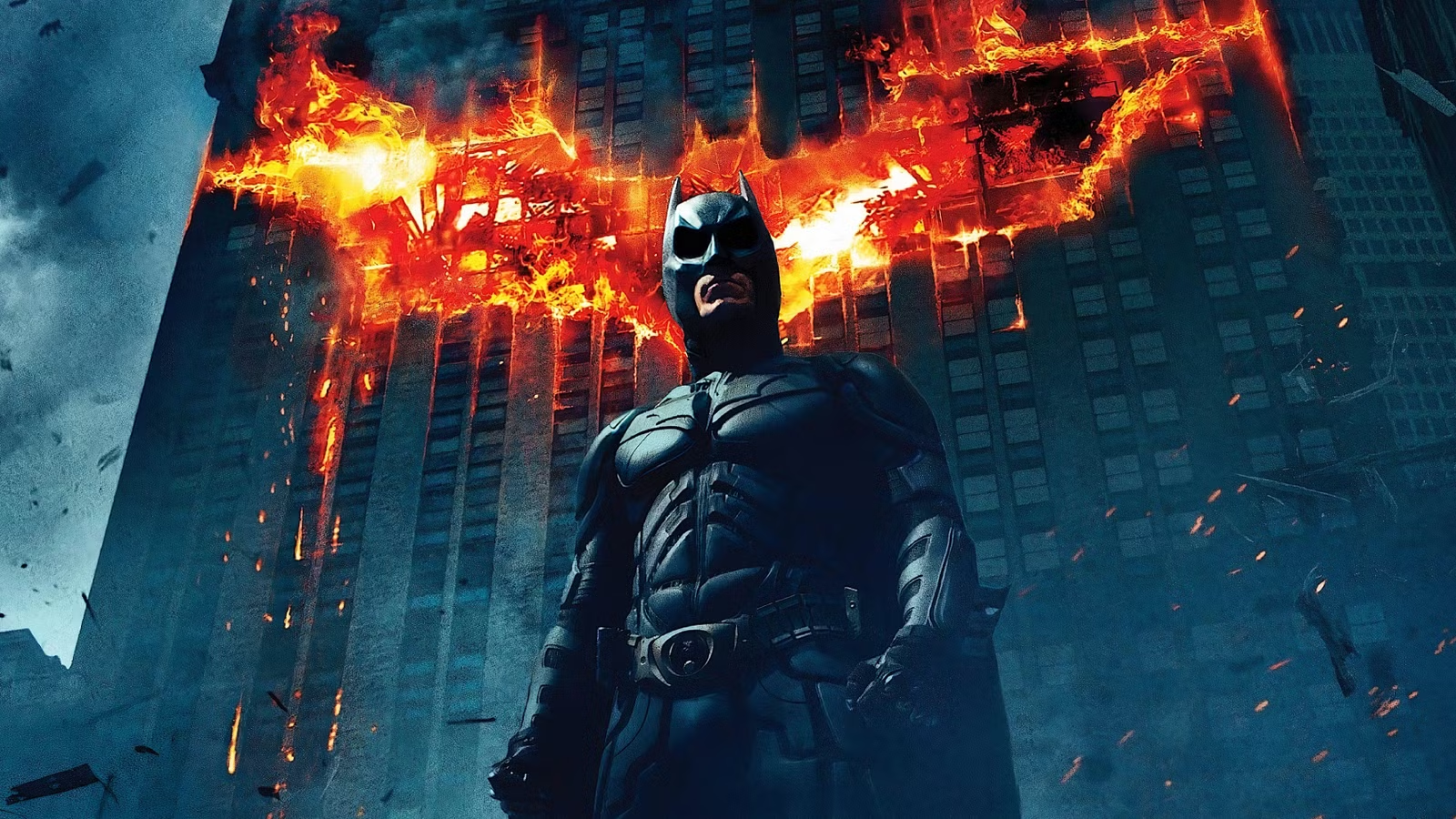
Some films entertain you, while others entirely dominate the atmosphere of the theater itself. The Dark Knight absolutely belonged to the second category. The energy and the adrenaline that took over the theater that night are something I still remember very vividly, making it one of my favorite theatrical experiences of all time.
Batman (Christian Bale), with the assistance of Lt. Gordon (Gary Oldman) and the new District Attorney Harvey Dent (Aaron Eckhart), works to take down the organized crime families who have a stranglehold on the streets of Gotham. But they soon find themselves up against a far more dangerous adversary in the Joker (Heath Ledger), an agent of chaos who unleashes a wave of mayhem across the city.
There has rarely been a more unhinged figure in mainstream cinema than the Joker, and Heath Ledger’s legendary performance elevates the character into something far more terrifying than a conventional comic-book villain. What makes him so frightening is not merely what he does, but what he represents. In The Dark Knight, the Joker ultimately wins on an ideological level. By corrupting Harvey Dent, Gotham’s so-called white knight, and transforming him into the vengeful Two-Face, he proves that morality is far more fragile than society likes to believe and that even the noblest people can collapse under enough pain, grief, and pressure.
The Joker, an anarchist and self-proclaimed agent of chaos, spends the entire film trying to prove that civilization and moral order are flimsy constructs held together by lies, compromise, and desperation. And the most disturbing part is that he never needs brute force alone to succeed. Instead, he manipulates people into betraying their own values and lets chaos do the rest. Streaming on Max.
4. Se7en (1995) – David Fincher

Se7en was one of the first films that started my cinematic journey, and it totally changed the way I thought about what movies could do emotionally and psychologically. Not only is it one of the best serial-killer movies, but it’s also one of the best police procedurals, with one of the most shocking and soul-crushing endings in cinema history.
The movie follows two homicide detectives, David Mills (Brad Pitt) and William Somerset (Morgan Freeman), as they hunt down serial killer John Doe (Kevin Spacey), whose atrocities are based on the seven deadly sins, forcing the detectives to play a cruel and twisted theological game.
David Fincher’s remarkable craftsmanship is on full display in Se7en. He creates a bleak and suffocating world through a grim color palette, relentless rain-soaked atmosphere, and slow-burning tension, making it feel as though evil lurks in every corner of the frame. The modus operandi of the killings is grotesque and absolutely diabolical. But this isn’t only for shock value. Here, the killer, John Doe, is attempting to prove a point with his killings: humans are hypocritical by nature, humanity is irredeemably corrupt, and everyone is guilty of the seven deadly sins.
In the infamous final “What’s in the box?” scene, John Doe wins a moral victory, as Mills’ actions vindicate his philosophy. The sheer clarity of thought, unwavering conviction in his actions, and calm demeanor while committing these heinous acts make the whole experience even more terrifying and nightmarish. After watching the movie, you will think there is no hope left, no place for morals, and no way to undo the decay of society, which has taken over all of us. Se7en is a masterclass in storytelling and one of the most unforgettable thriller films ever made. Available on Netflix.
3. Oldboy (2003) – Park Chan-wook

Oldboy takes the idea of revenge and twists it into something tragic, grotesque, operatic, and unforgettable, demonstrating why Park Chan-wook feels like a filmmaker operating on an entirely different cinematic wavelength from almost everyone else working today and why he remains my current favorite filmmaker.
The film follows Oh Dae-su (Choi Min-sik), a businessman who is kidnapped and held captive for fifteen years. After his escape, he seeks revenge on his captor, Lee Wo-jin (Yoo Ji-tae), and embarks on a brutal journey of vengeance, obsession, and psychological torment.
Oldboy isn’t your run-of-the-mill killer-hunter plot about a wronged man getting even. It’s more than simply physical anguish; this revenge has multiple layers. The villain creates an elaborate game in which he controls every action, anticipates every detail, and executes everything exactly as he wishes. A perfectly designed psychological trap. He does not simply want revenge; he wants emotional symmetry. He carefully designs his plan so that the protagonist experiences the same kind of psychological devastation and unbearable grief that once destroyed him.
The aftermath of the vengeance is so upsetting and mentally damaging that the protagonist would never be able to recover from it. It shatters his soul permanently, pushing the entire act beyond any recognizable moral boundary. It still gives me chills just thinking and writing about it. Here, evil doesn’t just prevail; it leaves no hope behind. Available on Amazon Prime Video.
2. Chinatown (1974) – Roman Polanski

I have written extensively about Chinatown and also included it in the list of best conspiracy thrillers of the 1970s here. Aside from that, the film features one of cinema’s most quietly terrifying villains.
Set against the scorching backdrop of pre-war California, private investigator Jake Gittes (Jack Nicholson) takes on what appears to be a normal infidelity case from socialite Evelyn Mulwray (Faye Dunaway). A simple case of adultery soon spirals into a web of personal and political intrigue, and Jake is sucked into a vortex of double-crosses and deadly deceptions.
Without revealing too much, the villain’s scary nature stems from his lack of morality and conscience, as well as his boundless power and influence. He exists above the very system created specifically to stop people like him. He is responsible for a massive water scam in the valley, in which he purposely dries out the land to impoverish farmers before buying their property at rock-bottom prices for a huge profit. Initially, the film centers on Jake uncovering a web of corruption and deceit. But as he digs deeper, he finds something darker and more sinister, an evil so absolute that it makes the film’s inclusion on this list entirely justified.
Apart from the water scam, what makes the villain truly monstrous is his history of incest with his own daughter since she was a child. To top it off, he has no regrets about it. Instead, he weaponizes his wealth and authority not only to cover up the water scam but also to take possession of the child born out of the incestuous abuse. And for all the crimes he’s committed, the system doesn’t punish him. No matter how hard Jake tries or how hard he works, he is ultimately powerless to do anything as corruption wins out over justice, money wins out over truth, and the evil walks away powerful and scott-free. The film’s iconic last line, “Forget it, Jake, it’s Chinatown,” neatly sums up the film’s bleak message: sometimes the bad guys win, and there’s nothing you can do about it. Chinatown is a benchmark for movies where the villain wins. Streaming on Paramount+.
Also read: 15 Best Conspiracy Thrillers of the 1970s
1. No Country For Old Men (2007) – Coen Bros

If there were ever a debate about the greatest villain in cinematic history, Anton Chigurh would walk into the conversation less like a man and more like death wandering through modern cinema. Out of all 18 films the Coen brothers directed together, No Country for Old Men easily stands as my favorite. It is also my favorite film of the 21st century, narrowly edging out There Will Be Blood (2007), and it easily tops the list of movies where the villain wins.
Adapted from the 2005 book of the same name by Cormac McCarthy, No Country for Old Men stars Josh Brolin as Llewelyn Moss, who discovers two million dollars in the middle of a Texas desert after a botched drug deal goes horribly wrong. A ruthless psychopathic hitman, Anton Chigurh (Javier Bardem), is sent to recover the money and eliminate Moss. On the other hand, Sheriff Bell (Tommy Lee Jones) investigates the growing trail of violence and bodies Chigurh leaves behind, feeling increasingly outmatched by the new kind of evil.
What makes him such a terrifying monster is the chilling clarity of his thinking and the terrifying mastery with which he carries out his craft: murder. He has a simple philosophy that regards murder as a matter of fate (determined by a coin toss). He approaches his profession in a meticulous, emotionless, and almost ritualistic manner. Here, the villain wins because there’s just no one who can stop him, which is a terrifying notion. The Coen brothers create a highly cynical world in which order is an illusion.
The film’s protagonist, Llewelyn Moss, is helpless against him (despite putting up the greatest fight), and even the second hitman, Carson Wells (Woody Harrelson), sent to neutralize Chigurh and Moss and collect the money, cannot thwart him either. Additionally, the character representing moral order, Sheriff Bell, retires in despair after realizing he can no longer make sense of the world around him or understand his place within it. As a result, he cannot stop the evil either. Chigurh ultimately triumphs because the evil has grown so ruthless and incomprehensible that traditional morality and human decency can no longer contain it. By the end, the film completely shits on the comforting belief that justice always prevails or that people eventually get what they deserve. In this world, justice was never designed to win, and the universe remains utterly indifferent to who deserves what. Available on The Criterion Collection and Prime Video.
25 Unforgettable Movies Where the villain wins links: IMDB, Wikipedia,
For more movie reviews and recommendations, visit our homepage
1970s 2023 Action Adventure alfred hitchcock Australian films black and white classic movies classics comedy Crime criterion collection denzel washington Drama folk horror free movies on youtube Gangster Giallo great films Horror indian movies lucio fulci Movies to watch Neo noir netflix netflix movies new movies new releases Noir Period Drama police procedural Psychological thriller Revenge reviews ridley scott Sci-Fi Sci fi supernatural suspense The Genre Junkie Thriller toshiro mifune war Western whodunit
2 thoughts on “25 Best Movies Where the Villain Wins, Ranked”
Comments are closed.