
Essential Westerns of the 2020s: The Western genre has always intrigued me because it is a potent reflection of America’s myths, contradictions, dreams, and changing identity beneath the familiar imagery of cowboys, outlaws, and frontier violence. Originally, I was going to compile a list of the greatest Westerns of the twenty-first century. But as I researched, I found that the 2020s alone already offered enough outstanding titles to warrant their own list. In just a few years, filmmakers like Martin Scorsese, Jane Campion, Kelly Reichardt, Jordan Peele, and Paul Greengrass have all made their mark on the genre, proving its versatility.
The Western genre has experienced a significant rebirth in popular culture, particularly on television. An important contributor to this resurgence of interest is Taylor Sheridan, whose modern frontier saga has expanded from TV shows like Yellowstone to 1883, 1923, Landman, and beyond. Even before that, Sheridan helped redefine the contemporary Western through his unofficial American Frontier Trilogy of Sicario (2015), Hell or High Water (2016), and Wind River (2017). Whether on the big or small screen, the Western is no longer a thing of the past. It is prospering.
A modern Western is a reimagining of old Western themes, archetypes, and conflicts in a modern, revisionist or unconventional setting. One of the defining features of the genre is its frontier setting, which can be anywhere from a desert to a remote town, a border region or isolated community, or simply a highway or open road. The setting itself becomes a character here, be it the deserts of Texas, the mountains of Montana, the plains of Oklahoma, or the isolated communities of the American frontier.
Traditional Westerns usually split the universe into good guys and bad guys, but contemporary Westerns love shades of gray. The heroes are usually complex, troubled, seeking acceptance, running from the past, or trying to find their way in a changing world, where the lines between good and evil are difficult to draw. In modern Westerns, violence is no longer a spectacle of heroism. It is shown as a consequence that is frightening, traumatic, and morally ambiguous. Western films dramatize complex issues such as colonialism, racism, capitalism, historical erasure, displacement, identity, and re-invention that classic Westerns tend to ignore or romanticize. Finally, neo-Westerns are remarkably flexible. They often incorporate elements of crime thrillers, horror films, science fiction, family dramas, road movies, and even love stories.
With all of that in mind, here are the 15 essential Westerns of the 2020s.
15. News of the World (2020) – Paul Greengrass

Paul Greengrass’ foray into the “western” genre, News of the World, is a simplistic, humane, yet emotionally effective road drama that resurrects the traditional wandering rider archetype while setting it in raw, troubled America in the 1870s.
In this adaptation of Paulette Jiles’ 2016 novel, Tom Hanks plays Captain Jefferson Kyle Kidd, a weary Civil War veteran who has taken to the road, moving from one small town to another and reading newspapers to eager audiences. In the course of his travels, he encounters Johanna (Helena Zengel), a 10-year-old girl whose family was killed by members of the Kiowa tribe. So, Captain Kidd offers to escort Johanna to the last vestiges of her family, and the two embark on a trek across the brutal Texas frontier, where both nature and man are ever-present dangers.
The film’s premise is about as simple as they come: Captain Kidd has to escort a young girl from one place to another. That means the film’s impact depends on two things: the relationship that develops between them and the obstacles they encounter along the way (the more dangerous challenges they confront, the greater the movie’s impact). Thankfully, it delivers on both fronts. Although Johanna is wary of trusting him at first, the girl soon finds solace in his presence, and the two develop a lovely bond reminiscent of a father-daughter relationship as Captain Kidd goes to extraordinary lengths to try to protect her and bring her safely to her relatives. At some point, you might stop and ask, “Why is this man risking everything for a total stranger?” The answer is surprisingly simple: he’s just a genuinely good man and believes in doing the right thing. The casting of Tom Hanks does much of the heavy lifting here. Having spent decades embodying honorable, compassionate characters, he makes Kidd’s unwavering goodness feel natural rather than forced.
On the adventure front, Captain Kidd and Johanna are traveling through the South, which has recently suffered a defeat in the Civil War. As a result, they are traveling through hostile territory where people are agitated, aggressive, and struggling to find their identities post-war. The duo endures one challenge after another on their journey throughout Texas. The biggest threat comes in the form of three bandits hell-bent on stealing the girl from Captain Kidd, leading to the film’s most memorable action sequence, a tautly choreographed sequence driven by the pure desperation of two people fighting for their lives. Along the way, they also travel through Erath County, where a racist militia led by a cattle lord captures them and forces Kidd to recite propaganda. Besides the human threat, the brutal Texas terrain presents its own host of problems, from punishing heat and thirst to a fierce sandstorm.
Like many Westerns, News of the World grapples with ideas of displacement, modernization, and disappearing identities. Captain Kidd, a Civil War veteran who reads newspapers from town to town, fights to survive in a world undergoing transition. Thematically, the film explores the aftermath of violence, cultural displacement (a girl torn between Kiowa culture and white American society), belonging, trauma (especially the child who has lost her family), and the rebuilding of human connection in difficult circumstances. Though the third act loses some momentum at times as the journey meanders, the film’s strong emotional base keeps it interesting.
14. Let Him Go (2020) – Thomas Bezucha

Let Him Go is a compelling, heartfelt, and suspenseful Western by Thomas Bezucha that has somehow slipped under the radar. After losing their son, retired sheriff George Blackledge (Kevin Costner) and his wife Margaret (Diane Lane) embark on a perilous journey from Montana to rugged North Dakota to save their young grandson from the vicious Weboy family, headed by the savage matriarch Blanche (Lesley Manville), whose son is married to the daughter-in-law of George and Margaret’s son.
What makes the film work so well is the ability to take a simple premise and create tension around it. Once the couple sets off to find their grandson, the film’s success hinges on the challenges they face and how they overcome them. Luckily, the screenplay excels in both these aspects. The Weboy family is genuinely a scary bunch, a lawless and unpredictable family that becomes a formidable opponent for the aging couple. There are some tense, anxiety-causing confrontations between the couple and the Weboy family, most notably the motel sequence and the shocking climactic showdown.
The relationship dynamics between Margaret and George are also what make the film so poignant and emotional. There is a lived-in intimacy, a mutual respect, and the kind of deep companionship that only a long-term marriage has, and they obviously and sincerely love and care for their grandson Jimmy—especially Margaret, who will do whatever it takes to save him from the Weboy family and bring him home. The film explores loss, parental love, family, and the limits of justice in a changing America. Costner and Lane give subtle performances full of deep grief and resolution, while Manville is terrifying as Blanche, an utterly intimidating force of nature. Let Him Go shows that the Western sense of retribution and moral reckoning still lingers on in the modern heartland.
13. The Settlers (2023) – Felipe Gálvez

Felipe Gálvez’s promising directorial debut, The Settlers, is breathtakingly atmospheric, unsettling in its unflinching look at colonialism, and an uncompromising revisionist western that is audacious but imperfect in execution.
Set in the cold plains of Tierra del Fuego in 1901, at the southernmost tip of South America, the film follows three men: a Scottish ex-lieutenant, Alexander MacLennan (Mark Stanley); a Texan mercenary, Bill (Benjamin Westfall); and a mestizo marksman named Segundo (Camilo Arancibia), whom a powerful and influential landowner hires to carve a route through indigenous territory for his sheep empire.
The film’s vast, brutal landscapes, lawless frontier, and perpetual tension and unease create an eerily dramatic setting while the three main characters are literally committing genocide for the sake of capitalism’s expansion and progress. I was fine with the film’s slow pace and long takes because they let us sink right into the violent, chaotic world. That said, I did find fault with the lack of character development of the three main characters, as well as the uneven storytelling and tonal inconsistencies, particularly in the third act, where the decision to keep certain major events (especially the final massacre) off-screen robs the story of some much-needed emotional and dramatic payoff. So, the film’s efforts to address issues like genocide and colonialism don’t have the punch they should.
Still, the film does dig into themes of racism and the complicity of mixed-identity folks caught between worlds through the character of Segundo, whose silent, anguished gaze is a great vehicle for expressing his increasing interior torment—a man unwittingly complicit in the systematic genocide of the Selk’nam people while slowly losing pieces of his own identity. The Settlers isn’t perfect, but it’s definitely worth a watch.
12. Eddington (2025) – Ari Aster

Following Beau Is Afraid, Ari Aster returns with another divisive film, Eddington, a satirical neo-western that transforms a dusty New Mexico town into a tinderbox of COVID pandemic-era fear and factionalism.
Set in May 2020, at the height of the COVID-19 pandemic, the film tells the story of Joe (Joaquin Phoenix), the sheriff of the small New Mexico town Eddington, who is distrustful of public health mandates and refuses to wear a mask, considering them an infringement on personal freedom. Joe runs for mayor against the charismatic, pro-lockdown mayor Ted Garcia (Pedro Pascal) in a hotly contested election. The race exacerbates tensions in the town, sparking violence and splitting neighbors, while the controversial AI data center threatens to deplete the town’s scarce water supply.
Aster employs the dry Southwestern terrain to create a timely film about right-wing conspiracy theories, racial unrest, corporate greed, power struggles, and how both sides of the political spectrum are preoccupied and divided while real power (influential people with higher political and corporate interests) triumphs, fracturing American reality itself. Phoenix gives another tense, unsettling performance as a man unraveling from a perceived loss of freedom, while Pascal exudes charismatic authority. The makers cleverly swap “Western conflicts” like territorial disputes and outlaw violence for culture wars, misinformation, and cancel culture outrage, turning Eddington into a combustible arena of ideology and hate. In doing so, the film captures how divided America is today in ideology, politics, culture, and even basic facts. It also depicts a society struggling to find its way between truth and lies, neighbor and enemy. Eddington stands as one of the most ambitious, polarizing, and original films of the 2020s.
11. The Harder They Fall (2021) – Jeymes Samuels
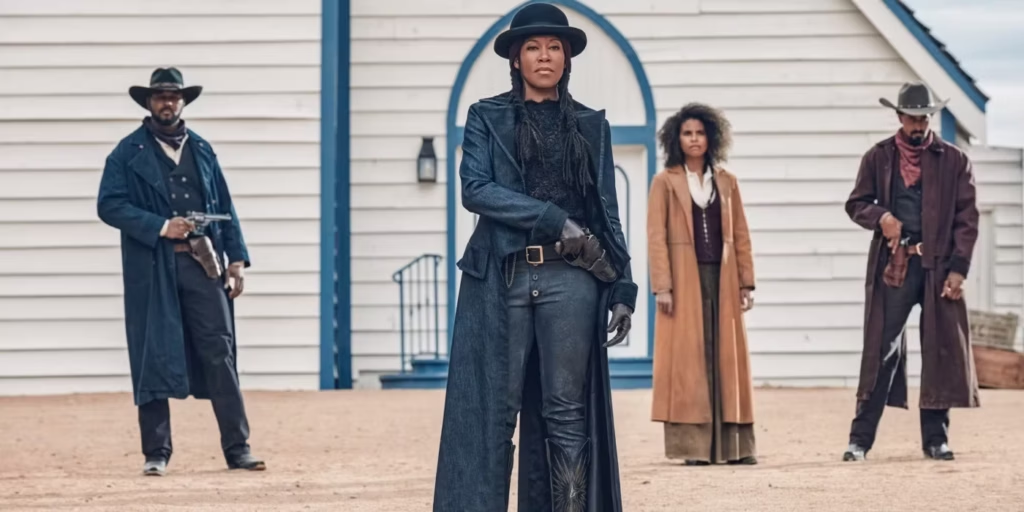
The Harder They Fall, directed by Jeymes Samuels, is a great example of a simple, generic story done right. It has a great cast, an amazing soundtrack, and striking, hyper-stylized visuals that combine modern cool with old-school frontier justice while injecting some fresh black swagger into the neo-Western genre.
Set in a reimagined 1890s American West, the film follows Nat Love (Jonathan Majors), an outlaw who gathers a posse of legendary Black gunslingers to exact revenge on the ruthless Rufus Buck (Idris Elba), a powerful crime boss who murdered Nat’s family when he was a child and is now fresh out of prison.
It’s a Western that packs all the classic ingredients (explosive shootouts, outlaws bound by a code, sun-baked vistas) while bravely subverting the genre’s whiteness. Given this is Jeymes Samuel’s first feature as director, the confidence on display is extraordinary. His direction is stylish, energetic, and constantly inventive, making full use of long tracking shots, sweeping cable-cam movements, and striking split-screen compositions that sync perfectly with the music. Add in the stylized slow-motion shootouts and vibrant color palette, and the result is a film that feels tailor-made for the big screen.
Nat Love vs. Rufus Buck is the classic good-guy/bad-guy rivalry that explores justice, vengeance, and morality. The film is also an homage to legendary real-life Black icons (Stagecoach Mary, Cherokee Bill, and Bass Reeves) as it explores how the American West was shaped by both opportunity and violence. Overall, The Harder They Fall is the coolest western since Django Unchained (2012) and deserves its place among the best westerns of the 2020s for its visceral action (especially its expertly choreographed climactic showdown), memorable characters, and captivating performances.
10. The World to Come (2020) – Mona Fastvold

Norwegian filmmaker Mona Fastvold’s The World to Come is a heartbreaking, emotionally rich period lesbian romance in which the western landscape becomes a frontier for quiet defiance and aching desire.
Set in 1850s America, the film follows Abigail (Katherine Waterston), a dutiful housewife trapped in a loveless marriage to the impassive Dyer (Casey Affleck) while struggling to cope with the grief of losing her young child to illness. But all that changes with the arrival of spirited Tallie (Vanessa Kirby), Abigail’s new neighbor, with her husband, Finney (Christopher Abbott). The two women quickly form a deep bond during the harsh isolation of frontier life.
Instead of resorting to traditional Western tropes, Mona Fastvold depicts everyday human struggles such as endless labor, brutal winters, emotional isolation, and the harsh realities of frontier life. Narration is employed here to great effect not only to reveal the characters’ innermost thoughts and conflicts but also to lend the film a poetic, melancholic tone. I loved how their relationship develops from common experiences of loss, isolation, and loneliness. Having said that, my one gripe is that the director somehow withdraws from fully embracing their growing intimacy and love for each other as the film progresses. Because of this, their relationship ultimately feels more like a brief but meaningful seasonal romance than the passionate love story the narrative seems to be heading for. Having said that, when they are separated in the third act, the aching and longing for each other’s company is well conveyed.
The film examines female agency and queer romance in a patriarchal world and how their forbidden relationship evolves into a quiet act of defiance. One of the film’s best assets is its gorgeous cinematography. Shot on 16mm Kodak film stock, in natural light, in a wide 2.35:1 aspect ratio, its rich, grainy, organic texture feels dreamlike and grounded, producing images that are as ravishing as they are harsh. Kirby and Waterston are both terrific, imbuing their performances with warmth, vulnerability, and authenticity. Together they share an effortless chemistry that becomes the film’s emotional anchor. The film is a loving and sad-eyed vision of the American frontier, showing how love can bloom in the most hopeless places and under the most savage circumstances.
Also read: 25 Unforgettable Movies Where the Villain Wins
9. The Dead Don’t Hurt (2023) – Viggo Mortensen

Viggo Mortensen’s sophomore directorial feature, The Dead Don’t Hurt, which he also wrote, produced, scored, and starred in, is a profound, introspective, and deeply human revisionist western that fits ideally on this list of best westerns of the 2020s.
Set in the 1860s, the film follows Vivienne Le Coudy (Vicky Krieps), a fiercely independent woman who travels to San Francisco with a Danish immigrant, Holger Olsen (Viggo Mortensen), to make a life in remote Nevada. But when Holger signs up and goes off to fight in the American Civil War, Vivienne is left to survive on her own in the corrupt town of ruthless men.
Mortensen’s choice of a non-linear approach proves wise. He avoids plot mechanics in favor of emotional resonance, offering us a close-up view of Vivienne’s journey (instead of showing the same cliched tropes of a classic western). The fragmented storytelling reflects the fractured nature of memory itself, presenting her character piece by piece. The non-linear narrative also sidesteps predictability, offering dual perspectives (Vivienne’s narrative of quiet endurance and Holger’s archetypal Western arc of revenge and return), thus giving the film a more reflective and poignant tone. Mortensen defies audience expectations by emphasizing domestic endurance, immigrant striving for belonging in a divided nation, and survival through Vivienne’s character, rather than shootouts, heroism, and traditional genre tropes.
The film provides a new female perspective in the Western genre, offering a point of view that, despite its prevalence, remains relatively uncommon within its conventions. It’s about love and separation, resilience and the human need for independence, in a hard, unforgiving world, especially for women. Vicky Krieps is memorable and magnetic as an independent, strong woman who faces life’s challenges without ever surrendering her spirit. The Dead Don’t Hurt is a sympathetic, elegiac portrait of endurance and humanity set in the blood and dust of the Old West.
8. Rebuilding (2025) – Max Walker-Silverman

For a genre that’s known for violence, revenge, and shootouts, “Rebuilding” is a welcome surprise. Max Walker-Silverman crafts a gentle, deeply compassionate story that swaps out bullets for empathy and makes you feel like you’ve just received a warm hug.
Dusty (Josh O’Connor), a reserved, divorced cowboy from South Colorado, suffers a devastating loss when a wildfire destroys his ranch. The disaster places Dusty in a makeshift FEMA trailer camp, where he gradually bonds with his young daughter and ex-wife while also making unexpected friendships among the survivors.
The vast, indifferent western expanses are threatened not by settlers or outlaws but by climate-driven wildfires that annihilate acres of land in no time. As Dusty copes with the loss, we see the changing dynamics with his daughter and ex-wife and his acceptance into a lovely community whose members have also lost their homes. Together they confront grief, bureaucratic uncertainty, and the long process of starting over, drawing strength from resilience, friendship, and human connection.
The film touches on themes of fatherhood, grief, survival, and humanity’s fragile relationship with nature in an age of environmental upheaval. Josh O’Connor gives another brilliant and understated performance as Dusty, a simple but compassionate man who, rather than running from tragedy (as he initially wants to), chooses to face it with quiet determination, emotional honesty, and a steadfast commitment to rebuilding both his ranch and his fractured family. Rebuilding is a heartfelt and deeply meditative film that deserves a place on this list.
7. She Rides Shotgun (2025) – Nick Rowland

The plot of She Rides Shotgun practically screams “South Korean thriller.” It has the same blend of raw emotion, escalating danger, and deeply personal stakes that filmmakers there have perfected over the years. Instead, the film comes from Nick Rowland, and to his credit, he absolutely nails the execution. Following the gritty brilliance of Calm with Horses (2019), he delivers a Western crime thriller that is as emotionally affecting as it is suspenseful.
Based on Jordan Harper’s 2017 novel of the same name, She Rides Shotgun begins with newly released ex-con Nate (Taron Edgerton), who must do everything he can to protect his 11-year-old daughter, Polly (Ana Sophia Heger), after a powerful Aryan gang targets them both. They are up against a ruthless gang with scarce resources and no one to trust as they travel through the New Mexico badlands, trying to survive in the face of constant danger.
The story of a young girl and an adult man (her father in this case) fleeing from dangerous people is nothing new; we’ve seen it in movies like Logan (2017), Leon the Professional (1994), Man on Fire (2004), and others. The impact and effectiveness of these films depend on the emotional core (primarily the connection between the child and the man) and the crime angle. This film works well on both fronts, with a father-daughter journey of vulnerability, growth, and hard-won trust and a gritty, high-octane crime story against the stark Southwestern landscape. There are some genuinely endearing moments between father and daughter, like him bleaching her hair, teaching her how to swing a baseball bat, or her tending to his wounds when he is injured, as well as the smaller moments of quiet bonding throughout their journey that make their relationship feel authentic and emotional.
Along with that, the film maintains its tension and intensity as a cat-and-mouse thriller in which the two are pursued by the dangerous white supremacist Aryan Steel gang, led by a self-proclaimed god. The action sequences are thrillingly staged and emotionally charged, mostly because Rowland shoots them from Polly’s perspective. Witnessing the violence through the eyes of a young girl deepens the sense of fear and vulnerability, especially in the tense car chase and the heartbreaking climactic finale. Rowland and cinematographer Wyatt Garfield set the film in the American Southwest, and the austere beauty of the wide, unforgiving desert landscapes is captured with painterly but grounded cinematography that uses natural light and expansive vistas to ratchet up tension and underscore the emotional stakes of the chase. Taron Egerton is intense as troubled protector Nate, and young Heger is impressive as Polly, who grows from a shy bookworm into a tenacious survivor.
6. Nope (2022) – Jordan Peele

After delivering Get Out (2017), one of the finest horror films of the twenty-first century, and its highly impressive follow-up Us (2019), filmmaker Jordan Peele returns with yet another bold and original vision in Nope, a genre-bending western that is daring, nerve-racking, and distinctly modern.
The film takes place in Aqua Dulce, California, and centers on siblings OJ (Daniel Kaluuya) and Emerald Haywood (Keke Palmer), who train and work with horses for film production but are now struggling to save their family ranch after their father dies from random objects falling from the sky. As more weird stuff starts happening in their area and they investigate further, they realize that they are up against a massive UFO hiding behind a cloud. The siblings try to capture footage of the UFO and profit from it with the help of Angel Torres (Brandon Perea), a tech salesman, and Antlers Holst (Michael Wincott), a renowned cinematographer. But it’s not as easy as it sounds.
Hoyte Van Hoytema’s use of large-format IMAX 65 mm film, anamorphic lenses, and a 2.39:1 aspect ratio creates a visually stunning and eerily tense experience that amplifies the sense of mystery and isolation in the vast and desolate Californian landscapes. In classic Westerns, the primary threat is usually outlaws, figures who represent chaos and lawlessness by robbing, killing, and terrorizing frontier communities. “Nope” is a smart subversion of that trope from Jordan Peele. Instead of bandits on horseback, he presents us with a gigantic predatory organism lurking in the skies above, a merciless creature that hunts, kills, and eats whatever is unfortunate enough to get in its way. Here Peele takes the threat from the ground, which consists of shootouts and ambushes, to the vertical frontier of the sky, providing a different viewing experience that will keep you glued.
At its core, Nope examines humanity’s tendency to turn everything into a spectacle, whether it’s trauma, tragedy, or even mortal danger. Simultaneously, Peele critiques the erasure of Black contributions from entertainment history through the Haywood siblings, whose family horse-ranching business remains closely tied to Hollywood, even as the family’s lineage has largely been erased from the industry’s dominant narratives. “Nope” is a great example of how the Western genre has evolved into new forms. The frontier is still open, and something is always watching from above.
5. Old Henry (2021) – Potsy Ponchiroli

I’d been putting off watching Old Henry since it was released in 2021. You know how it goes: certain films keep getting pushed further down the watchlist as newer and shinier titles compete for your attention. One of the joys of making lists, though, is that it finally forces you to catch up on those long-overlooked gems. Old Henry is exactly that kind of discovery. As a taut, slow-burning western, the film generates an astonishing amount of tension from a deceptively simple premise.
In the Oklahoma Territory, widowed farmer Henry (Tim Blake Nelson) and his teenage son lead a peaceful life. One day, they reluctantly take in a mysterious wounded man, Curry (Scott Haze), who is carrying a sack full of money. Things become considerably more complicated when Sheriff Sam Ketchum (Stephen Dorff) rides onto the property with a group of armed men and a story that may or may not be true. Suddenly, Henry finds himself walking a dangerous tightrope, forced to decide who can be trusted while doing everything in his power to keep his son from finding out who he really is.
While the plot is straightforward, the screenplay has an unpredictability that keeps us interested throughout, whether that’s the real identities of who the true sheriff is and who the robber is from Curry or Ketchum or keeping Henry’s past a mystery. The climactic reveal of Henry’s past is a genuinely surprising and brilliantly executed twist that Western fans are sure to enjoy. Here the film deconstructs the myth of the gunslinger and strips away the romanticism of frontier justice, portraying violence as brutal, tragic, and deeply consequential. The film deals with themes of redemption, fatherhood, and the inescapability of the past.
In addition to its suspenseful plot, Old Henry is a terrific character study. Henry is a man on the run from his past, a man who has exchanged a life of violence for the simple routine of a farmer. He has withdrawn so completely from the outside world that it might as well not exist for him. Part of that isolation stems from fear. The world is changing, and Henry doesn’t know where he belongs anymore. He keeps his son close and sheltered and prevents him from exploring the outside world, determined that Wyatt shall not make the same mistakes he did, much to the boy’s frustration. The result is a tense, loving, yet strained relationship that gives the film emotional depth, taking it beyond a simple Western thriller. The film simmers with tension from the moment Curry walks into Henry’s house, and it just builds from there, especially in sequences like Henry’s first encounter with Ketchum and the climactic shootout, making for an exceptional viewing experience. Old Henry is a must-see for fans of the genre.
Also Read: More Than Action: 10 Best Kung Fu Movies Beyond Fighting
4. First Cow (2020) – Kelly Reichardt

Regardless of what Quentin Tarantino might say, Kelly Reichardt has been one of the most prolific filmmakers of this century and has established herself as one of the most distinct voices in American cinema with a remarkable body of work that includes Old Joy (2006), Wendy and Lucy (2008), Meek’s Cutoff (2010), Certain Women (2016), and others. Her 2020 Western “First Cow” is a meditative, thoughtful, yet simplistic film that embodies the qualities that have come to define Reichardt’s filmmaking.
The film, which is based on the 2004 novel Half-Life by Jonathan Raymond, takes place in 1820 Oregon and follows the unlikely friendship between Cookie, a kind-hearted and talented cook played by John Magaro, and King Lu, an immigrant from China, played by Orion Lee, a resourceful man with a savvy business mind. Together, they hatch an unlikely business plan of stealing milk from the only cow in town, owned by the wealthiest landowner in the area, and turning it into delicious oily cakes. In doing so, they form a small business that quietly thrives in a world changing by the advent of capitalism.
Reichardt is known for her unique brand of filmmaking, which includes slow pacing, minimal dialogue, a meditative tone that is thought-provoking rather than exciting or tense, and visuals that prioritize atmosphere and mood using natural lighting. “First Cow” also contains all of these elements. The film is a meditation on friendship, survival, the birth of American capitalism, and the immigrant experience. The cow becomes a symbol of wealth, exploitation, and opportunity in a changing world.
Reichardt’s revisionist approach removes all genre trappings and instead focuses on everyday life and the harsh realities of the American West. Christopher Blauvelt’s cinematography is beautiful, capturing damp forests and muddy landscapes, with naturalistic lighting that creates an atmosphere that is both authentic and engrossing. John Magaro and Orion Lee give deeply sincere and humane performances as Cookie and King Lu, and their chemistry, organic friendship, and companionship serve as the film’s emotional core. “First Cow” is a refreshingly unique revisionist western and one of the finest films the genre has produced in the 2020s.
3. Bacurau (2020) – Kleber Mendonça Filho, Juliano Dornelles
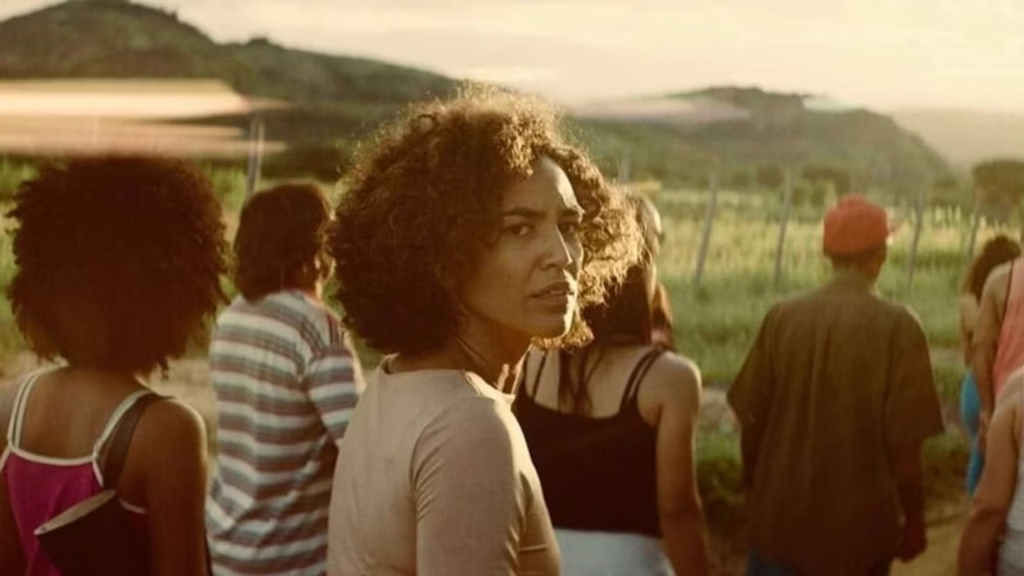
A wild and bonkers genre-bending film, Bacurau, from directors Kleber Mendonça Filho and Juliano Dornelles, mixes western, science fiction, political satire, and surrealism to explore themes of colonialism, revenge, and resistance.
The film is set in the remote near-future Brazilian town of Sertão. After the death of the town matriarch, strange events begin. Eventually, people are murdered, and the entire community is pitted against a group of wealthy foreign hunters who view the village as prey.
The first act introduces the audience to the important characters and close-knit community of Bacurau, a tiny town in the middle of nowhere that has been politically neglected despite its inhabitants’ struggles with poverty and food and water shortages. The second act opens with a series of strange happenings—the town disappearing from maps, cell phones losing service, unexplained deaths, unexpected blackouts, and the arrival of bizarre outsiders—transforming the movie into a paranoid sci-fi mystery thriller. Things heat up in the third act as the identity and motives of the mysterious outsiders are revealed, and a visceral, gory 30-minute battle for revenge ensues.
Here, the filmmakers deliberately flip and subvert Western tropes, portraying the “cowboys” as the bad guys and armed invaders and the “native people” as the heroes fighting for survival. This film is a brutal critique of colonialism and class disparity and an investigation into the ideas of community resistance and unity. The cinematography is a sight to behold, with its expansive, sun-drenched Brazilian Sertão landscape and a lonely, forlorn locale, while the doom and dread are only heightened by the slow, deliberate pacing. Bacurau is one of the most audacious and unforgettable westerns of the modern age.
2. The Power of the Dog (2021) – Jane Campion

Westerns have always been a haven for stereotypically masculine characters—those who wear huge hats, wield loud weapons, and talk a lot of smack. What’s rarely been explored is the emotional and sexual complexity underneath those grizzled exteriors. And that’s where Jane Campion’s The Power of the Dog sets itself apart, turning a familiar Western landscape into a fascinating study of repression, desire, and vulnerability.
The Power of the Dog, based on Thomas Savage’s 1967 novel of the same name, is set in 1925 Montana and follows two wealthy Burbank brothers, namely the charismatic and compassionate George (Jesse Plemons) and the intimidating and hyper-masculine Phil (Benedict Cumberbatch), whose lives are disrupted after George marries a widow named Rose (Kirsten Dunst) and brings her, along with her sensitive son Peter (Kodi Smit-McPhee), to join him on their sprawling cattle ranch.
The film mostly takes place in a large house in the middle of nowhere, surrounded by stunning jagged mountains and golden fields. The ranch becomes a remote and claustrophobic place of mental warfare, power plays, and hidden lusts. The claustrophobic atmosphere, along with Johnny Greenwood’s haunting score, keeps the tension simmering, making you suspect something sinister is happening underneath the surface of this broken family. In the beginning, the film generates its tension from the psychological tug-of-war between Rose and Phil, with every interaction feeling like a battle for control. Gradually, that dynamic is replaced with something far more complex as Phil’s relationship with Peter takes center stage. As the layers of Phil’s character are peeled back, The Power of the Dog reveals itself to be less a family drama and more a haunting examination of the effects of emotional repression in the violent, harsh, and male-dominated American West.
The film explores toxic masculinity, power struggles, repressed homosexuality, and how men put on a tough and manly front to fit in with society or their environment. Cinematography by Ari Wegner is one of the film’s greatest strengths. She uses ARRI Alexa LF and Alexa Mini LF cameras with Panavision Ultra Panatar 1.3x anamorphic lenses to create lush skin tones and stunning images throughout. The expansive 2.39:1 frame takes in the vast open spaces and dazzling imagery of Montana, while the naturally lit interiors, with shadows and muted earth tones, evoke a sense of quiet apprehension. Benedict Cumberbatch is excellent as Phil, a man brash and unlikeable but whose cruelty masks a deep vulnerability. The Power of the Dog sees the West not as a land of heroic freedom but as a prison for unspoken truths and buried identities.
1. Killers of the Flower Moon (2023) – Martin Scorsese

I’ve seen 25 of Martin Scorsese’s 26 feature films as a director (the lone exception being Boxcar Bertha), and I’ve revisited several of them more times than I can count. Yet somehow, I’ve never written about a Scorsese film. That changes with Killers of the Flower Moon. A sprawling three-and-a-half-hour epic and Scorsese’s first true venture into the Western genre, it stands as another artistic peak for one of cinema’s greatest living filmmakers and, in my view, the best Western of the 2020s so far.
Based on David Grann’s novel, the film chronicles the systematic murders of members of the Osage Nation in 1920s Oklahoma after vast oil reserves are discovered beneath their land. At the heart of the tragedy is the troubled marriage between Ernest Burkhart (Leonardo DiCaprio) and Molly Kyle (Lily Gladstone), an Osage woman whose relationship is manipulated by Ernest’s powerful rancher uncle, William Hale (Robert De Niro).
Killers of the Flower Moon started as a classic crime thriller narrated from the perspective of an FBI agent looking into the deaths of members of the Osage Nation. However, Scorsese and his team felt the script lacked emotional depth and would ultimately play out as just another standard thriller. Instead of telling the story through the eyes of the people investigating the crimes, Scorsese made the far more interesting choice of centering it on those living through them. By changing the focus to Molly and the Osage community, the film ceases to be a conventional whodunit and becomes something much more personal, tragic, and unsettling. Unlike in typical westerns, the villains aren’t loud or flashy cowboys or gunslingers. They are cunning, smiling predators who will tell you what you want to hear, wait in the shadows, then knife you in the back the first chance they get.
The film does a great job of immersing us in the Osage world while also showing us the hardships their community is suffering. The movie’s depiction of ethnic cleansing, which is systematic, clever, brutal, and barbaric, is unlike anything I have seen before in cinema. These characters (culprits) are so dehumanized and desensitized that it all feels like a silly little game to them. Similar to many of Scorsese’s films, including Goodfellas (1990), Casino (1995), The Wolf of Wall Street (2013), The Aviator (2004), and The Irishman (2019), Killers of the Flower Moon follows a familiar rise-and-fall narrative structure. What keeps it consistently engaging is Thelma Schoonmaker’s masterful editing, which alternates between long, observational takes that allow the performances to breathe and sharp, rhythmic cuts during moments of tension and violence. Together with the immersive sound design and Robbie Robertson’s haunting score, it makes for a film that sustains its momentum throughout its three-and-a-half-hour run time.
Both Leonardo DiCaprio and Robert De Niro get to play unique and intriguing characters, with the former playing Ernest, a weak-willed, malleable, and cowardly character who is being played like a puppet by the puppet master, his uncle William Hale, an outwardly genial yet chillingly calculated and ruthless mastermind who orchestrates and executes his evil plan of community extinction. Thematically, it explores settler colonialism, greed, racial capitalism, the disposability of Native lives, and the slow corruption of love and trust (via Molly and Ernest’s relationship). Killers of the Flower Moon is a modern western masterpiece from one of the finest directors of all time.
Also Read: Best Neo-Noir Films of the 2020s
15 Essential Westerns of the 2020s Links: IMDB, Letterboxd, Wikipedia
For more movie reviews and recommendations, visit our homepage
1970s 2023 Action Adventure alfred hitchcock Australian films black and white classic movies classics comedy Crime criterion collection denzel washington Drama folk horror free movies on youtube Gangster Giallo great films Horror indian movies lucio fulci Movies to watch Neo noir netflix netflix movies new movies new releases Noir Period Drama police procedural Psychological thriller Revenge reviews ridley scott Sci-Fi Sci fi supernatural suspense The Genre Junkie Thriller toshiro mifune war Western whodunit