
Best Hong Kong action movies: Watching Kenji Tanigaki’s The Furious (2025) recently sent me down the rabbit hole of Hong Kong action movies. The history of Hong Kong action cinema is vast, but the 1980s and early 1990s were something else, with a young generation of filmmakers bringing restless creativity and almost reckless energy to the screen. The deeper I went, the more I realized just how willing they were to take risks, push physical limits, and completely rethink what action could look like. And honestly, a lot of contemporary action cinema feels tame by comparison.
From John Woo’s operatic gunplay to Jackie Chan and Sammo Hung’s daring physical comedy, from Wilson Yip’s grounded intensity to Johnnie To’s stylish crime thrillers, each brought a distinct voice to the medium through sheer craftsmanship and fearless filmmaking. Putting this list together was a steep learning curve for me, as I learned what defines heroic bloodshed, how to analyze martial arts action choreography, and how different eras shaped its evolution. The result is a selection that, for me, captures the incredible range of Hong Kong action cinema.
It moves from heroic bloodshed and old-school kung fu to martial arts action comedy, modern crime thrillers, hard-edged police action, and cult classics. These aren’t simply the 20 most famous Hong Kong action films; they’re the ones that impressed, surprised, or stayed with me the most. I ranked them by action choreography, filmmaking, emotional impact, influence, and, perhaps most importantly, how much they still kick ass today.
So, here are my 20 best Hong Kong action movies.
20. The Magnificent Butcher (1979) – Yuen Woo-ping

If you’re in the mood for some old-school martial-arts madness, The Magnificent Butcher is an easy recommendation. It’s funny, energetic, packed with incredible fights, and stars Sammo Hung in one of his early leading roles, with the famous Hong Kong martial arts expert Yuen Woo-ping behind the camera.
The film centers on Lam Sai-wing (Sammo Hung), a good-natured but hot-tempered disciple of Wong Fei-hung (Kwan Tak-hing) whose jolly disposition and feisty conduct land him in constant trouble. When a series of misunderstandings and deliberate framing by the rival Five Dragons school, led by the ruthless martial artist Master Ko (Lee Hoi-san), makes him the prime suspect in a rape and murder case while Wong Fei-hung is away, he must rely on his fellow students (including a young Yuen Biao) and a drunken beggar named So (Lam Ching-ying) to clear his name and face his adversaries.
The plot is rather predictable, but the web of framing, kidnapping, and continual misunderstandings keeps things engaging and lively throughout. The humor is hit-and-miss for me since not all the gags land, but the film is buoyed by increasingly energetic action sequences that are inventive and incredibly well choreographed. The sequence that sticks out for me is the calligraphy fight between Master Ko and Wong Fei-hung, where Wong just calmly keeps on writing while fending off Ko’s attacks. The brush and ink become part of the fight, turning what should be a simple writing session into a brilliant display of precision, control, and martial-arts skill. It’s a wonderfully rhythmic sequence that says a lot without ever spelling it out. Wong remains calm while everything around him is chaotic, and that becomes the real demonstration of his skill: knowing how to keep your head when the pressure is at its highest.
Another standout sequence is the courtyard fight between Yuen Biao and Master Ko’s henchman, played by Lam Ching-ying. It’s long, cleanly staged, and remarkably easy to follow, while Biao seems almost weightless as he flips, kicks, and changes direction with incredible balance and aerial control. Then Sammo Hung gets his moment in the epic showdown with Master Ko, where his speed, strength, and agility are on full display. The fight builds up beautifully and is among the best pure kung-fu sequences of its era, finishing off the film with a blast of spectacular martial-arts choreography. For fans of the genre, The Magnificent Butcher is a real hidden gem that elevates Sammo Hung from supporting stunt coordinator to formidable leading man.
Looking for more Asian action films? Check out the review of the Kill (2023) movie
19. Royal Warriors (1986) – David Chung

If I had to describe Royal Warriors in one word, it would be “badass.” David Chung’s film has the attitude, action, and sheer physicality to earn the label, and it remains one of the standout “girls with guns” films of the 1980s.
When Hong Kong policewoman Michelle Yip (Michelle Yeoh), Japanese Interpol agent Yamamoto (Hiroyuki Sanada), and air security officer Michael Wong (Michael Wong) foil a plane hijacking, they become the targets of a group of former Vietnam veterans who vow revenge after their fellow members are killed during the failed rescue attempt.
The film maintains an unrelenting tempo throughout its brief 96-minute duration. The story isn’t overly complicated, and frankly it doesn’t need to be. It’s a simple game of cat-and-mouse where every victory for the heroes is met with something even nastier from the villains. The danger keeps increasing, the stakes keep getting higher, and the tension never lets up for a second before the explosive finale. The romance between Michael and Michelle, though, is another matter. Forced and unnecessary, like the movie suddenly decided it needed a love story.
But as an action film, I was curious to see what was in store for me, and boy, was I not disappointed! The action in this picture is an insane spectacle and an absolutely top-notch cinematic experience. The tense, cramped plane fight that opens the movie is already a hell of a start. But then you get a terrific car chase, a chaotic nightclub shootout, and a completely bonkers finale involving an armored vehicle and a chainsaw-wielding villain. The set pieces are fast, nasty, and full of inventive little touches that make them ridiculously fun to watch. Michelle Yeoh is breathtaking as an action star and delivers an amazing physical performance, while Sanada brings a balance of icy coolness and burning rage that grounds the film emotionally. Royal Warriors is a perfect example of quintessential 1980s Hong Kong action cinema.
Next read: The 13 Best Action Films of 2025
18. Riki-oh: The Story of Ricky (1991) – Lam Nai-choi

If you’re researching Hong Kong action cinema and somehow haven’t stumbled across Riki-Oh: The Story of Ricky, prepare yourself. This is one of the most ridiculous and bizarre films I’ve encountered, throwing martial arts, prison exploitation, cartoonish violence, and outrageous splatter into one gloriously chaotic package.
The film, set in a privatized jail in 2001, follows Ricky (Fan Siu-wong), a martial artist with superhuman power who is sentenced to prison for the manslaughter of a criminal lord who murdered his girlfriend. Inside the prison, he quickly clashes with the corrupt warden and a gang of increasingly deadly inmates known as the Four Heavenly Kings, forcing him to fight his way through the system.
Truthfully, the weak acting and lack of story frustrated me at first, but once the gore kicked in and I realized it was a full-blown splatter film, I acclimated and started having a great time. If you’re hoping for narrative depth or character development, you’ve come to the wrong place. This film serves a platter of pure, unadulterated genre excess that prioritizes shock, spectacle, and imaginative practical effects over everything else. After realizing it was a splatter film, I expected creative, extravagant, visually arresting gore and over-the-top, practically executed violence—and the film more than met my expectations.
You’ll see fists punching through the stomach, chest, and head; eyeballs popping out of sockets; faces sliced off with a knife and wood plane; intestines used to strangle a character; a character being fed into an industrial meat grinder; and bodies reduced to piles of gore and minced meat, among other things. Not for the squeamish, as the movie is a relentless parade of gory violence, with ludicrously excessive bloodletting from beginning to end. If you have a stomach for these things, Riki-oh: The Story of Ricky is one of the most amusingly bizarre and creative Hong Kong cult movies I’ve seen.
17. Dragons Forever (1988) – Sammo Hung
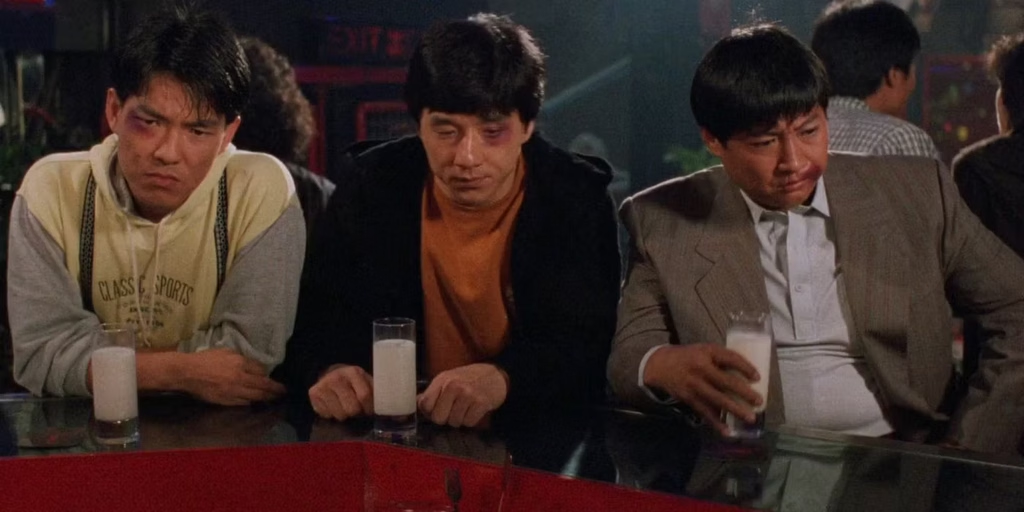
Jackie Chan, Sammo Hung, and Yuen Biao, famously known as the “Three Dragons,” made six films together, with Dragons Forever serving as their final collaboration. Project A is still my favorite, but Dragons Forever delivers some of the most spectacular pure martial-arts action the trio has ever put on screen.
Jackie Chan stars as Jackie Lung, a slick lawyer hired by Hua Hsien-wu (Yuen Wah) and his shady chemical company to discredit Miss Yip (Deannie Yip), the owner of a fishery suing the company because its factory operations threaten her livelihood. As Jackie becomes romantically involved with Wen (Pauline Yeung), the rival lawyer representing Miss Yip, he enlists the help of his friends, the opportunistic Wong Fei-hung (Sammo Hung) and the eccentric but morally upright lawyer Tung Tak-biao (Yuen Biao). But the three soon discover that the chemical company is involved in criminal activities far more dangerous and serious than they initially suspected.
I actually prefer Dragons Forever to Wheels on Meals (1984). The story feels stronger to me, and once the film reaches its second half, the action becomes more focused, and the stakes feel much higher. Jackie and Wong’s romantic subplots do drag on a little longer than they need to, but I still found them charming enough to work, adding some warmth to the characters before the film goes all-in on the action. Here, the trio gets more screen time together, and their chemistry is electric and volatile as they spar and play off each other brilliantly, both physically and verbally, generating several laugh-out-loud moments, especially in the sequence where Jackie invites Wen over for dinner and Wong and Tung unexpectedly turn up, throwing the whole evening into chaos.
The film picks up pace in the final act, with a series of dynamically staged, physically demanding fights that rank among the best action the trio delivered together. We get plenty of great fights along the way, especially the mid-film warehouse sequence, but nothing quite prepares you for the factory finale. It’s an extended action showcase packed with excellent individual bouts and brilliantly staged group combat.
The ultimate showdown between Jackie Chan and the villain’s henchman, played by Benny “The Jet” Urquidez, is one of the film’s true highlights, with Sammo Hung’s choreography allowing the fight to build up organically, each exchange getting tougher and more ferocious until the two are throwing everything they have at each other. You can feel every punch and kick as they launch into a series of vicious, coordinated attacks, and I can’t remember the last time I saw Jackie Chan fight with such ferocity (the only other time that comes to mind is in Wheels on Meals, where he faces Benny again). Dragons Forever is an essential entry in the list of best Hong Kong action films.
16. PTU (2003) – Johnnie To

When a filmmaker has delivered as many bangers as Johnnie To has over the years, calling him one of the defining figures of Hong Kong cinema doesn’t feel like much of a stretch. PTU (2003) is one of his finest examples, a tense, stylish, tightly written 87-minute neo-noir action thriller that squeezes a remarkable amount of atmosphere and suspense into its brief runtime.
The trouble starts when Lo Sa (Lam Suet), an anti-triad sergeant, loses his gun during a run-in with a group of young gang members. Worried that losing the gun could end his career, he asks his friend Mike Ho (Simon Yam), head of the Police Tactical Unit, to help him find it. What starts as a simple attempt to recover a missing weapon soon turns into a long, increasingly complicated night of rival gangs, disappearing evidence, and trouble waiting around every corner.
Set across a single night in neon-soaked Hong Kong, PTU turns the city into a character of its own. Its streets and alleys are never just a backdrop; they become a constantly shifting space where cops, gangsters, and trouble keep crossing paths. Johnnie To is one of the few directors who can maintain tension in a scene. The opening hot pot restaurant sequence tells you exactly what kind of film you’re watching. It’s quiet and restrained, but tension is everywhere, built through how the characters occupy the room, the rhythm of their movements, and the unspoken rules everyone seems to understand. It’s a perfect taste of what’s to come.
Johnnie To builds pure cinematic pressure-cooker situations through atmosphere, geography, precise staging, and controlled set pieces, rather than relying on action alone. When the action finally breaks out in the climactic shootout, the carefully built tension explodes in a sudden, chaotic burst of violence that resolves every intersecting conflict at once.
Under the missing gun and the bedlam of the night, PTU is pretty interested in the uneasy world of cops and crooks. It looks at gang rivalries, loyalty among officers, and the uncomfortable space between what the law allows and what people do when the law gets in the way. Lam Suet convincingly plays Inspector Lo—desperate, inept, and sweaty—and Simon Yam gives a standout and confident performance as Mike. PTU may not be as action-packed as the other films on the list, but it more than makes up for it with Johnnie To’s astute and economical direction, dry humor, and a strong sense of place.
15. Righting Wrongs (1986) – Corey Yuen

Righting Wrongs is one of the rare occasions when Yuen Biao carries a film without Jackie Chan or Sammo Hung beside him, and he makes the most of it. The result is one of the most criminally overlooked action films of the 1980s, with set pieces good enough to stand alongside the likes of Police Story (1985) and even Mission: Impossible – Fallout (2018).
Yuen Biao portrays Jason Ha, a righteous prosecutor frustrated by the corrupt justice system that lets criminals go free. After a key witness and his family are murdered, Ha takes the law into his own hands, beginning to eliminate those responsible. His path crosses with Inspector Cindy (Cynthia Rothrock), a tough, highly skilled police officer determined to stop him. As they dig deeper, they uncover a web of corruption linked to the superintendent of police, Wong Ching-wai (Melvin Wong).
What sets this film apart from many martial arts films of its era is that it replaces comedy with meanness and bleakness, giving the action a colder, more ruthless edge. The script does something fascinating: every character you begin to like and root for ends up dying, making you hate the villain even more as the film progresses. Melvin Wong absolutely nails the villainous role. He gives the character a poisonous mix of ruthlessness, arrogance, and icy smugness, making him the kind of bastard you love to hate.
With Yuen Biao and Corey Yuen sharing choreography duties, the film delivers a terrific mix of fast, physical, and varied action. The fluid choreography takes great advantage of Yuen Biao’s athleticism, showcasing his trademark acrobatics—flips, aerial kicks, and inventive use of his surroundings—front and center. His battle with the villain’s henchman, Black Assassin (Peter Cunningham), is a prime example.
Cynthia Rothrock brings a harder edge to the action. Her kicks are crisp and powerful, but it’s the sheer determination behind every move that really sells her fights. She also has a commanding presence, which makes her a delight to watch. Her fight with the white female assassin at the shopping mall and multi-level parking garage is a great example.
I’d be remiss not to mention the intense climax, where Yuen Biao and Melvin Wong trade brutal blows in a hangar before the fight escalates into a desperate mid-air struggle aboard an airplane. Yuen Biao takes things to another level of insanity. He actually hangs from the outside of a plane at high altitude, giving us one of the film’s craziest practical stunts. Sorry, Tom Cruise, but Biao got there first, nearly 40 years earlier, when Hong Kong action filmmakers were apparently operating with a very different definition of workplace safety.
14. Drunken Master 2 (1994) – Lau Kar-leung

Drunken Master 2 is Jackie Chan firing on all cylinders. Lau Kar-leung builds the fights like beautifully crafted pieces of martial arts choreography, and Chan tears through them with ridiculous agility, perfect timing, and a willingness to get battered for our entertainment. The result is a film that is as thrilling as it is entertaining.
Set in early 20th-century China, the story follows Wong Fei-hung (Jackie Chan) as he accidentally gets caught up in a British scheme to smuggle Chinese artifacts out of the country. At the same time, he clashes with his strict and righteous father, Wong Kei-ying (Ti Lung), over his forbidden use of drunken boxing, while his lively stepmother, Ling (Anita Mui), brings her own brand of comic chaos into the household.
The film has a thin plot that primarily serves as a framework for action and comedy. The reason for this film’s low ranking is that its humor didn’t work for me, especially compared with so many other Jackie Chan films. It felt dated, and I even found myself checking out in places. Some set pieces also feel like they go on longer than they need to. The opening train fight between Fei Hung and the Manchurian officer Fu Wen-chi is a good example, as is the market fight where Fei Hung drinks and unleashes drunken boxing for the first time. Both sequences feature some great choreography, but a tighter edit would have made them more impactful. The comedic gag about the Ginseng medicine also stretches on too long, feels repetitive, and tests the audience’s patience before the larger action sequences take over.
The action is where Drunken Master 2 really comes alive, and it’s a big reason the film deserves a spot on the list. Jackie Chan throws everything he has into the choreography, turning the street fights into wonderfully chaotic displays of physical comedy and martial-arts skill. Then comes the steel-foundry finale, which is simply insane. Chan fights while increasingly intoxicated, surrounded by fire, molten metal, and industrial machinery, and somehow keeps going. It’s breathtaking, exhilarating, and ridiculously entertaining.
13. Police Story 3: Supercop (1992) – Stanley Tong

If you’re an action junkie, Police Story 3: Supercop is hard to resist. It has that wonderfully reckless Hong Kong madness where you can almost feel the makers risking their lives for every shot, and the action keeps escalating until you’re just sitting there thinking, “How the hell did they film this?”
Inspector Kevin (Jackie Chan) is dispatched to mainland China to infiltrate the criminal network of Chaibat (Kirk Wong), a powerful drug lord. He teams up with Michelle Khan (Michelle Yeoh), a tough, disciplined Chinese officer who goes undercover as Chan’s sister. As they infiltrate the gang, the danger of exposing their true identities grows greater as they seek evidence to bring the organization down.
Stanley Tong replaces Jackie Chan in the director’s chair for the third Police Story, and you can immediately feel the difference in scale. The film is far more globe-trotting than the first two, moving from mainland China and Hong Kong to the Thailand-Cambodia border region and Malaysia while taking the franchise’s action to a whole new playground.
Maggie Cheung returns as May, Chan’s girlfriend, while Bill Tung is back as Uncle Bill, Kevin’s immediate superior, and both slip comfortably back into their familiar roles. They provide plenty of comic relief, while Chan brings his trademark slapstick and physical comedy. The standout gags include the goofy “Supercop” training demonstration, the undercover fake-family reunion with Bill Tung hilariously playing the mother, and the jealous confrontation that erupts when May unexpectedly turns up at the Malaysian resort. Even though these gags aren’t as laugh-out-loud funny as those in the previous installments, they’re still lighthearted and don’t feel stale, which works in the film’s favor.
The action sequences are where the film earns its classic status. Instead of leaning as heavily on pure martial-arts choreography as the earlier films, Tong goes bigger and more Western with the action. The helicopter finale is the obvious showstopper, especially when Chan is left dangling from a ladder suspended beneath the helicopter as it sweeps over the city. Then there’s the insane train sequence, where Yeoh rides her motorcycle onto a moving train that is just mind-blowing. And don’t skip the end credits. The outtakes showing how these insane sequences were actually filmed are almost as entertaining as the movie itself. Seeing the actors and stunt team doing all of this for real, with no safety net of modern CGI, is genuinely jaw-dropping.
Michelle Yeoh is a welcome addition to the franchise and is the film’s secret weapon. She is magnetic and stern and has a perfect rapport with Jackie Chan, rather than being his sidekick. In the action sequences, Yeoh is every bit Chan’s equal, matching him beat for beat while performing her own stunts. She has the physical ability to keep up with him, but what really stands out is the confidence and commanding screen presence she brings to every fight.
12. SPL: Kill Zone (2005) – Wilson Yip

My exploration of Wilson Yip’s filmography began with Ip Man (2008), which I adored and included on my list of the Top 10 Best Kung Fu Movies Beyond Fighting. But even before that, in 2005, Wilson Yip delivered SPL: Kill Zone, a terrific martial arts crime thriller with strong heroic bloodshed undertones that helped revitalize Hong Kong action cinema in the 2000s.
Veteran detective Inspector Chan (Simon Yam), the leader of a police unit, is diagnosed with cancer and is close to retirement, determined not to leave the force until he’s brought down ruthless crime lord Wong Po (Sammo Hung) by any means necessary. Inspector Ma (Donnie Yen) replaces Chan and brings a very different approach to the job. Wong Po’s increasingly brutal tactics create tension within the unit and push everyone toward a violent collision.
The film is really about a police unit that has spent years trying to bring down the untouchable Wong Po. They keep hitting the same wall. Every legal route leads nowhere, so eventually desperation gets the better of them, pushing them into things they would normally never consider, including tampering with evidence. But these aren’t just colleagues doing a job. They’re a tight-knit group who genuinely care about each other, which makes their increasingly desperate choices feel personal rather than simply plot-driven. I also like how the film handles Inspector Ma’s arrival. As Chan’s replacement, he is initially an outsider, but the film takes its time showing him earn the unit’s trust and find his place among them.
However, some of the emotional beats, such as Detective Chan adopting the child of a murdered witness (whom Wang Po had killed) and Wang Po as a caring family man, feel generic, forced, and overly dramatic, slowing down the narrative. But the film isn’t on the list for that reason; it’s for its action, which is ultra-brutal and visceral, blending traditional kung fu with realistic MMA techniques (grappling, ground fighting, and brutal close-quarters combat).
The film’s third act is absolutely frenetic and high-octane, with two scenes that stand out as all-timers. The first one is an alley fight between Ma and Wang Po’s sadistic assassin, Wu Jing. The action choreography is absolutely jaw-dropping, and the close-quarters fights are tight, brutal, and beautifully controlled, with knife work, baton techniques, and split-second timing coming together without the film needing to hide behind flashy cuts or effects. The film saves the best for last, with the climactic battle between Ma and Wang Po, featuring choreography that is fierce, hard-hitting, and relentless, as two of the best martial artists, Donnie Yen and Sammo Hung, go toe-to-toe against each other, delivering a fight sequence that will be remembered for ages. Any film featuring two Hong Kong legends trading punishing blows is worth seeking out.
Check out 10 Best Kung Fu Movies Beyond Fighting here
11. Exiled (2006) – Johnnie To

Johnnie To has spent decades finding new ways to play with the crime genre, and Exiled might be one of his coolest experiments. It’s a hard-edged, surprisingly emotional action thriller that creates a tight, uneasy atmosphere and keeps you on edge from start to finish.
Set in 1998 Macau, the film opens with two hitmen, Blaze (Anthony Wong) and Fat (Lam Suet), arriving at the home of Wo (Nick Cheung), a former gangster who betrayed their boss Fay (Simon Yam) by leaving his gang and trying to kill him. Tai (Francis Ng) and Cat (Roy Cheung) soon show up to protect Wo, but the situation takes an unexpected turn: all five men are old childhood friends. What should have been a straightforward hit instead becomes a complicated mess of loyalty, friendship, and orders they aren’t sure they can follow.
With its themes of brotherhood, loyalty, characters bound by codes, stylized gunfights, and a strong sense of fatalism and tragic nobility, the movie stands as a late example of heroic bloodshed. Male bonding is nothing new in heroic bloodshed, but Exiled is one of the rare films where I genuinely felt the friendship between the five hitmen. Their loyalty never feels manufactured or played for cheap sentiment. It’s there in the way they sit around a table, joke with each other, pull each other’s legs, and immediately have one another’s backs when things go bad. Their friendship feels lived-in, and that’s what gives the film much of its emotional punch.
Johnnie To clearly draws inspiration from spaghetti westerns, particularly Sergio Leone’s films, and creates almost unbearable tension with long, deliberate setups before each shootout, making the eventual bursts of violence far more impactful. The film features at least three memorable shootout sequences, including the one in Wo’s apartment, another at an underground clinic, and the climactic shootout. The framing is meticulous, the poses are almost absurdly cool, and the exaggerated gunplay unfolds with a rhythm that feels more like choreography than violence. Exiled is cool as hell, quietly melancholic, and packed with the kind of stylish action that leaves you completely satisfied once the credits roll.
10. Fist of Legend (1994) – Gordon Chan

Gordon Chan’s Fist of Legend, a remake of Bruce Lee’s 1972 classic Fist of Fury, is a technically and stylistically superior film to the original, which is why it makes the list instead of the original. It is also one of the purest martial arts action films of the 1990s and a high point in Jet Li’s career.
The film is set in 1937 Shanghai during the Japanese occupation and follows Chen Zhen (Jet Li), a Chinese student in Japan, who returns home after hearing of his master’s mysterious death. As he investigates, he becomes convinced that his master was murdered, which puts him at odds with the Japanese martial-arts community and Gō Fujita (Billy Chow), the powerful Japanese military officer.
The remake doesn’t simply retell the same story; it adds a welcome nuance and gives the characters more depth. It makes Chen Zhen into a quieter, more introspective, measured, and conflicted character torn between personal loyalty, national pride, and a forbidden romance with a Japanese woman. The film also softens the original’s nationalistic rage by depicting some Japanese characters as honorable, morally complex, and good-natured.
The action is where the film really earns its reputation. Yuen Woo-ping keeps the choreography clean, physical, and easy to follow, but what I really love is how much character he puts into the fights. The classroom brawl is a lot of fun, the dojo confrontations are beautifully handled, but the final battle with General Fujita is the one I can’t shake. It isn’t simply two guys beating the hell out of each other; the choreography becomes part of the storytelling rather than serving as a spectacle.
The sequence opens with Chen trying his customary tactics against the big, tough, super-strong Fujita, who initially overpowers him quite easily. Seeing this, Chen changes his approach and style, finds Fujita’s weaknesses, breaks down his habits, alters his tactics, and gains the upper hand. Just when you think Chen has figured him out, Fujita finds a way back in. That constant back-and-forth is what keeps the sequence so gripping. More importantly, it puts the film’s central idea into action: skill isn’t about being the strongest guy in the room; it’s about knowing how to adapt when strength alone isn’t enough. I couldn’t take my eyes off it. Jet Li brings a calm, controlled presence to Chen while handling some brutally demanding choreography.
9. Full Contact (1992) – Ringo Lam

Full Contact feels like Ringo Lam’s meanest answer to the heroic bloodshed craze. It’s raw, bloody, stylish as hell, and drenched in nihilism, taking the familiar themes of friendship and betrayal and pushing them into much darker territory. The story follows Jeff (Chow Yun-fat), a professional thief who gets betrayed during a heist and is left for dead. Somehow, he survives, and from there it’s all about revenge. His target is Judge (Simon Yam), a flamboyant, sadistic crime boss, and members of his crew, including Deano (Frankie Chan) and his girlfriend, Virgin (Bonnie Fu).
Despite its predictable revenge plot, Full Contact stands out for the way the makers treat the story. Ringo Lam makes everything feel harsher and more cynical, stripping away much of the sentimentality and leaving the characters trapped in a world where loyalty can turn sour very quickly. The heist is the perfect introduction to that world, spiraling down into a glorious mess of bullets, blood, and mayhem. The characters are larger than life and defined more by their over-the-top personalities and quirks than by any deep psychological exploration.
Simon Yam plays the villain, a flamboyant, openly gay, sadistic, and unhinged crime boss whose theatrical personality makes him impossible to ignore. Then there’s Virgin, who is wild, hypersexual, and a nutcase (she was masturbating in the car with Jeff during the heist scene), and her lover, Deano, is impulsive and violent. Finally, Jeff has the familiar Chow Yun-fat cool, but Lam gives it a harder edge. He’s leaner, meaner, and far more physical, with none of the effortless romanticism of some of Chow’s earlier anti-heroes.
The action is slick without losing its brutality, and the climactic nightclub shootout is easily the standout. Lam’s “bullet-cam” shots track the bullets as they fly through the room, giving the sequence a frantic, kinetic energy that feels completely out of control. It’s a wild visual flourish that is excessive, flashy, and sticks in your head days after the film is over. Full Contact is Hong Kong action cinema at its nastiest.
8. Eastern Condors (1987) – Sammo Hung

I went into this film completely blind, and I was pleasantly surprised to find it to be one of the best men-on-mission films ever made. Eastern Condors turned out to be a triumphant fusion of peak Hong Kong action mastery and peak ’80s macho action tropes.
The setup is wonderfully simple: Ching (Sammo Hung) leads a bunch of Chinese-American prisoners and soldiers on what amounts to a suicide mission into Vietnam. Their job is to reach an abandoned American weapons depot and destroy it before the enemy can claim it. Along for the ride are To (Yuen Biao), a highly skilled fighter, Billy (Billy Lau), who always seems to have a trick up his sleeve, and Wan (Yuen Wah), a seasoned soldier, among others. Once they cross into hostile territory, things get ugly fast, and the group has to fight its way through heavily armed enemies and brutal terrain to stay alive.
Sammo Hung skips the character development and elaborate setup and jumps right into the action. Once the action begins, the film unleashes a relentless barrage of gunfights, explosions, and martial-arts set pieces across the Vietnamese jungle. Although the film’s tone is uneven as it alternates between grim wartime drama and playful Hong Kong humor, and character development is intentionally thin, while also under-exploring the local Vietnamese and Cambodian struggles, the sheer kinetic energy and craftsmanship more than compensate. Also, I have mixed feelings about the film’s villain. On the one hand, the final fight sequence involving him is spectacular; on the other, his character is a little too cartoonish to be menacing and intimidating, which reduces the film’s overall impact.
The action is where Eastern Condors really go nuts. It’s rough, physical, and genuinely dangerous, but it’s also incredibly well-crafted. Sammo Hung choreographs the action alongside an all-star team that includes Yuen Woo-ping and Corey Yuen, resulting in wonderfully inventive, hard-hitting sequences. The stunt work is the real jaw-dropper, though. With such a big ensemble, almost everyone gets a chance to shine, whether it’s through a fight, a stunt, or a small character moment. Eastern Condors was a pleasantly surprising cinematic experience and an easy addition to any list of great Hong Kong action films.
7. Time and Tide (2000) – Tsui Hark

After his short stint in Hollywood, Tsui Hark came back to Hong Kong with Time and Tide, and he came back loud. The film barely slows down, piling gunfights, explosions, and increasingly ambitious and insane set pieces on top of each other while Tsui shoots everything with a relentless, hyperactive visual style. It’s the kind of movie that leaves you catching your breath when it’s over.
Tyler (Nicholas Tse) takes a job as a bodyguard after a chance encounter leaves him facing an unexpected pregnancy and forces him to grow up fast. Along the way, he crosses paths with Jack (Wu Bai), a former mercenary trying to leave his violent past behind and build a quiet life with his pregnant wife. But Jack’s past won’t stay buried, and Tyler is dragged into a deadly world of killers, gangsters, and shifting loyalties. Before long, the two men who started as friends find themselves caught on opposite sides of a violent underworld conflict.
Once the film gets its characters and setup out of the way, it basically turns into three enormous action set pieces, each one bolder and more ingenious than the last. They caught me completely off guard, and honestly, they blew my mind. The first set piece kicks things off with Jack pulling a complete switcheroo. He’s supposed to kill his father-in-law as a chance to rejoin his old gang called The Angels, but instead he takes out the head of the gang and escapes with their money right under their noses.
The second set piece is the real showstopper for me. Set among a cluster of towering apartment blocks, it’s one of those action sequences that makes you wonder how the hell they pulled it off. Jack is staking out his own apartment, waiting for the mercenaries watching him, when Tyler unexpectedly walks into the middle of it. What follows is a vertical game of cat and mouse, with everyone scrambling through stairwells, balconies, open courtyards, and cramped air shafts. At one point, Jack rappels down the inside of the building while the camera follows him into the dizzying drop. And when you think the madness is over, Jack’s apartment explodes, while Tyler barely escapes by hiding under a refrigerator. It’s completely bonkers, brilliantly staged, and genuinely nerve-racking.
The final sequence begins inside the railroad station and continues to a nearby concert stadium. The police enter the fight, turning it into a three-way war, while Jack’s pregnant wife gets caught in the middle and goes into labor right as the bullets and explosions start flying. She eventually gives birth, with her life and the baby’s hanging in the balance. It’s absolutely nail-biting stuff and impossible to look away from.
Beyond the relentless tension and anticipation, what makes these scenes work is Tsui Hark’s ambitious visual style. The camera is rarely still, constantly rushing after the characters and throwing us into strange, sometimes dizzying angles that make the chaos feel even more intense. The choreography is just as inventive because the characters are never fighting in a boring, flat space. Instead, the characters fight their way through a collapsing tenement, across railway tunnels and platforms, and even along high catwalks above a live concert. Every part of these locations gets used, whether someone is rappelling down a wall, crashing through a window, hiding behind a structure, or turning the surroundings into a weapon. That’s what makes the action feel so alive.
Marco Mak cuts the film with almost as much energy as Tsui Hark directs it. The editing jumps between rapid cuts, freeze frames, speed changes, and multiple angles, yet the action never becomes impossible to follow. That’s a difficult balance to pull off, and the film does it remarkably well. Time and Tide was easily one of my most pleasant discoveries while working on this list. Its rawness, rhythm, and sheer physicality completely caught me off guard, and I ended up loving the hell out of it.
6. Project A (1983) – Jackie Chan

Project A is Jackie Chan firing on all cylinders. The comedy lands, the adventure keeps moving, and the martial-arts action is bursting with flair and energy. More than anything, it feels like Chan is having an absolute blast at the height of his powers.
Set in early 20th-century Hong Kong, Project A follows Dragon Ma (Jackie Chan), a marine officer who has had enough of the pirates running wild along the coast and the corrupt officials constantly getting in his way. His problems only grow when he is teamed with Sergeant Hong Tin-tzu (Yuen Biao), a rival officer whom he loathes, and the two are forced to work together despite their constant friction. With trouble piling up, Ma has no choice but to call on his old friend Fei (Sammo Hung), a clever thief who knows how to get things done. Before long, the three are drawn into a larger scheme involving the ruthless pirate leader Luo San Pao (Dick Wei), forcing Ma and Hong to overcome their differences and fight side by side.
Project A is a riot of a film, a sheer cinematic joy that I had a smile plastered on my face throughout its runtime. While watching it, I was constantly amazed by the level of technical skill and physical commitment that must have gone into making the film. What makes this film work is a perfect blend of slapstick comedy (which works like a charm here, unlike Drunken Master 2), dazzling fight choreography, and an intriguing concept involving pirates, inter-service rivalry between the police and the Marines, and high-stakes coastal intrigue. I don’t think I’ve ever laughed so much and felt so anxious at the same time during an action sequence as I did watching this movie, whether it’s the bar brawl scene or the bicycle chase scene, which culminates in the iconic moment of Jackie Chan falling from the clock tower (a direct homage to Harold Lloyd that Chan performed multiple times).
The choreography is chaotic, feels spontaneous (even though choreographed), and delivers thrills and humor in equal, exhilarating measure. Also, the physical interplay between Jackie Chan, Sammo Hung, and Yuen Biao, who were all fellow Peking Opera School brothers, is joyful and always a treat to watch. I had an absolute blast watching this film, and I am confident you will as well, since Project A remains a pinnacle of 1980s Hong Kong action films.
5. Bullet in the Head (1990) – John Woo

For me, friendship is at the heart of John Woo’s cinema. His films don’t just feature male camaraderie; they are often built around it, with loyalty and brotherhood carrying as much weight as the action. He’s one of those directors, like Howard Hawks, Quentin Tarantino, and Judd Apatow, who know how to make male camaraderie feel genuine rather than simply written into the script. Bullet in the Head takes that bond and puts it through hell. It’s Woo at his most ambitious and emotionally brutal, while still delivering the explosive action you’d expect.
Three lifelong friends, Ben (Tony Leung), Frank (Jacky Cheung), and Paul (Waise Lee), run to Saigon after a violent incident in Hong Kong turns their lives upside down. They think they’re escaping their problems, but Vietnam only gives them bigger ones. Before long, they’re caught between the war and the criminal underworld, drawn into an arms deal and thrown together with Luke (Simon Yam), an enigmatic mercenary. But when the war escalates, the one thing they thought they could always count on, their friendship, starts to unravel in a world of greed, fear, and betrayal.
The film begins with youthful camaraderie and street-level gangster energy in 1960s Hong Kong and then takes a devastating, tragic turn into conflict, greed, and treachery in Vietnam. The screenplay, which moves from gangster drama to melodrama to war film, is Woo’s most political work. John Woo also takes influence from films such as The Deer Hunter (1978) and Apocalypse Now (1979), as he openly expresses his outrage at the Tiananmen Square massacre. The film hits hardest when it focuses on Luke, Frank, and Ben. Woo makes their brotherhood feel honest and deeply personal, which makes what happens between them so painful to watch.
And when Woo lets the action loose, the film becomes something else entirely. The slow-motion gunfights, explosions, flying bullets, and almost operatic staging are pure Woo. The action always serves the drama rather than serving it as a pure spectacle. The violence, whether it’s the riots, the nightclub shootout in Saigon, the battlefield and village sequences, or the brutal POW camp scenes, never feels like it’s there just to look cool. It always comes down to what these characters are going through.
Tony Leung is incredible as Ben, especially in the POW camp sequence, where he brings rawness and vulnerability that genuinely broke my heart. Of all the Tony Leung performances I’ve seen, this might be the one that’s stayed with me the most. Jacky Cheung is equally impressive, giving Frank a heartbreaking transformation, while Waise Lee makes Paul’s descent into greed feel painfully believable.
4. A Better Tomorrow (1986) – John Woo

A Better Tomorrow is John Woo at his sleekest and most stylish, and the film helped set the tone for Hong Kong’s heroic bloodshed era. Forty years later, it hasn’t lost its pull for me. It also catapulted Chow Yun-fat to major stardom and marked the beginning of one of the most memorable actor-director partnerships in Hong Kong cinema.
Ho (Ti Lung), a former triad member, wants to leave his criminal past behind and repair his relationship with his younger brother, Kit (Leslie Cheung), a dedicated police officer. Caught between them is Mark (Chow Yun-fat), Ho’s stylish and fiercely loyal partner in the underworld. But no matter how hard Ho tries to cut links with his triad, the allure of past allegiances and the criminal underworld keep thwarting his path to redemption.
The film’s style and look don’t feel dated to me (unlike others), and the reason is simple. I think that’s because Woo never treats the action as the main attraction, and it never feels hollow; it’s always tied to the characters and their emotions. Also, the action, which has since been imitated to death, was invented, not copied. It felt like the birth of a new language, with its gun-fu style featuring dual-wielded pistols, slow-motion gunfights, and explosive standoffs.
Look at the restaurant massacre. Mark storms in against the Taiwanese gangsters who betrayed Ho and put him behind bars, and the whole thing feels personal from the first shot. He’s not just there to kill people; he’s there because his loyalty to Ho has turned into pure rage. The confrontation at Kit’s place, the hospital sequence, and the finale work for the same reason—they’re fueled by what these characters feel, not just what’s happening around them. The action matters because there’s genuine emotion behind it—betrayal, guilt, loyalty, and redemption all feeding into the violence.
Woo doesn’t let the action overshadow the characters. The film embraces a healthy dose of melodrama, but it works because Woo gives the relationships enough weight to make you care about what happens to these men. And when it comes to male friendship, Woo is in a league of his own. The bond between Ho and Kit gives the film its emotional conflict, while Ho and Mark’s friendship gives it much of its warmth and loyalty. We connect with these characters and their relationship dynamics, and we can’t help but root for them and hope they make it through. What sets this film apart from a forgettable, empty, or campy spectacle you’d toss out of your mind the moment you leave the theater is Woo’s ability to keep us emotionally invested in these characters.
3. Police Story (1985) – Jackie Chan

To me, Jackie Chan is more than an action star; he’s a cinematic treasure. For over four decades, the man has thrown himself into danger, taken real punishment, and pushed his body to absurd limits to entertain us. That kind of commitment is rare, and it makes his contribution to cinema worth celebrating. As a performer and filmmaker, he changed what action choreography could be, inspiring countless filmmakers who came after him. Police Story is perhaps the clearest showcase of what made Chan special, and it remains one of the great Hong Kong action films.
A dedicated Hong Kong police inspector, Kevin (Jackie Chan), is tasked with protecting a key witness in a major case against powerful drug lord Chu Tao (Cho Yuen). The witness, Selina Wong (Brigitte Lin), becomes central to the investigation, while Chan must also confront the complications of his relationship with his girlfriend May (Maggie Cheung). As Kevin gets closer to the truth, things get messy fast, with Chu Tao’s men coming after him and corruption inside his own police force making it harder to know who he can trust.
Even though the film’s functional cops-versus-criminals plot may feel a little dated after all these years, its groundbreaking action set pieces and memorable comedic gags still keep you invested. The film’s two big action sequences are still spectacular, but the opening one is the real statement of intent. It begins with a raid through a hillside shantytown before exploding into gunfire and a frantic chase. Kevin takes off after the criminals by himself and somehow ends up hanging from a double-decker bus with an umbrella. It’s completely absurd, genuinely dangerous, and exactly the kind of physical insanity that makes Jackie Chan’s action so much fun to watch. It’s the perfect introduction to the film’s energy, with practical destruction, insane stunts, and Chan once again doing things that make you wonder how he survived them.
The climactic mall sequence is where Jackie Chan completely loses his mind (in the best possible way). The action moves across escalators and through glass displays, clothing racks, and mirrors, while motorcycles come crashing through glass barriers. Then comes the famous pole slide, with Chan sliding through several panes of glass before crashing through a canopy. It’s mind-boggling stuff and, for me, one of the greatest action sequences ever put on film.
Jackie Chan’s action choreography is fast, reactive, and opportunistic. He rarely rushes into a fight, instead letting his opponents come at him as he slips, dodges, and deflects their attacks, using whatever is around him to his advantage before striking the moment they leave an opening. The film also features some great comedy gags that will make you think of Buster Keaton and Laurel and Hardy, like the famous office phone-juggling scene or the cake-in-the-face running gag, in which Kevin’s face gets stuffed in cake multiple times at his surprise birthday party. Police Story is an ideal combination of high-energy action, light romance, and comedy, making it an excellent choice for anyone looking to get started in Hong Kong action cinema.
2. The Killer (1989) – John Woo

The Killer is John Woo firing on all cylinders—a landmark of Hong Kong’s golden age and one of the films that came to define heroic bloodshed. The gunfights are pure ballet, but the film’s real strength lies in the emotion underneath all that gunfire. Friendship, loyalty, honor, sacrifice—Woo throws everything into the mix and somehow makes it feel deeply personal.
Ah Jong (Chow Yun-fat) is a professional killer who wants out. He takes one last assignment, hoping it will give him enough money to leave the violence behind, but accidentally injures Jennie (Sally Yeh), a nightclub singer, and leaves her blind. Consumed by guilt, he becomes determined to make things right with her. Meanwhile, Inspector Li Ying (Danny Lee) is hunting him down. Their paths eventually collide unexpectedly, turning hunter and hunted into reluctant allies as they fight for their lives against the underworld.
The film’s first half carries a strong Le Samouraï (1967) influence. Ah Jong is betrayed by the people who hired him, falls for a singer he becomes determined to protect, and dreams of earning enough money to walk away from the life he has chosen. Woo also wears his Mean Streets (1973) influence openly, having dedicated The Killer to Martin Scorsese.
Ah Jong, much like Harvey Keitel’s Charlie, finds himself drawn back to the church whenever he needs somewhere to escape. It becomes a kind of sanctuary for a man drowning in guilt and violence and perhaps searching for a way to redeem himself. It’s also where Woo unveils the white dove, a visual motif that would become synonymous with his cinema. The birds bring an almost peaceful presence to scenes otherwise filled with bullets and blood. Woo would return to the image throughout his later Hollywood career, including Hard Target (1993) and Face/Off (1997).
The story itself is fairly simple, but that’s almost beside the point. What keeps The Killer gripping is the way Woo builds momentum from scene to scene, constantly tightening the screws without making it feel forced. Woo has a great sense of when to let a scene breathe and when to rip that calm apart. A quiet exchange can suddenly turn violent, and before the dust has settled, another escalation is already underway. It’s exhausting in the best possible way.
The film’s influential action choreography, improvised on set by Woo, is gloriously over-the-top, violent, and chaotic. His signature gun-fu turns gunplay into ballet, blending kung-fu-style movement with weapons, slow motion, expressive camerawork, and clear spatial geography. Characters dive through the air, bullets fly, and blood sprays, yet the action never feels empty or repetitive. Every shootout carries emotional stakes, whether it is Ah Jong’s relationship with Inspector Li developing or his feelings for Jennie. That’s why the action still hits so hard today; it looks incredible, but you actually care about what’s happening.
There’s something almost hypnotic about Chow Yun-fat as Ah Jong. He doesn’t need grand speeches or exaggerated gestures to command your attention; his presence does the work. It brought Alain Delon and Toshiro Mifune to mind, both of whom had that same gift for filling the screen with stoic grace, effortless cool, and an aura you simply couldn’t ignore.
Read the detailed analysis of The Killer movie here
1. Hard Boiled (1992) – John Woo

John Woo directed five heroic bloodshed films in Hong Kong before moving to Hollywood, and Hard Boiled is my pick of the bunch. The film’s emotional side works beautifully, but it’s the trailblazing action that really blows me away. Woo pushes his style to an almost ridiculous level, delivering set pieces that still feel astounding today. For me, it’s the perfect film that takes the top spot on a list of the best Hong Kong action movies.
In Hard Boiled, Chow Yun-fat plays Inspector Tequila, a hard-nosed cop determined to smash a ruthless gun-running outfit. After a botched raid, he teams up with Alan (Tony Leung), an undercover cop who’s spent years deep inside the criminal organization, now run by the brutal Johnny Wong (Anthony Wong). At first, it’s a reluctant partnership, but soon the two find themselves knee-deep in gang wars, police corruption, and an all-out war that forces them to depend on each other.
John Woo’s earlier films drew criticism for romanticizing gangsters and criminals. With Hard Boiled, he swings the other way, drawing inspiration from Dirty Harry (1971) and Bullitt (1968); he shifts his attention to the police and gives them the same larger-than-life treatment he gave the gangsters. Once Tequila and Alan’s characters are properly established, the screenplay takes its time building the unlikely friendship that develops between them.
Like Woo’s earlier heroic bloodshed films, Hard Boiled deals with brotherhood, loyalty, and what violence does to the people caught up in it. The film’s heart is the relationship between Tequila and Alan, which grows from suspicion into genuine respect and trust. I didn’t feel the same emotional punch I got from his other films, but Woo still makes you care about these two men, especially Alan, whose undercover life slowly becomes a hell of its own.
The three major action sequences in Hard Boiled each bring something different to the table. The teahouse shootout is where Woo’s craftsmanship really kicks in. Everything is moving at once—the camera, the characters, the bullets—but you always know what’s happening. It’s chaotic as hell, yet somehow incredibly easy to follow. The warehouse sequence adds character drama to the mayhem, as Alan faces Tequila for the first time and saves his life, giving their relationship a whole new weight. Then comes the hospital climax, an extraordinary escalation of danger that moves from a hostage situation to newborns caught in the crossfire. What makes all of it so exhilarating is that the spectacle comes from practical staging, blocking, timing, and coordination rather than digital effects.
Chow Yun-fat is effortlessly cool as Tequila, mixing toughness, dry humor, and physicality. Tony Leung is fantastic as Alan, keeping everything under the surface as he quietly conveys the regret, divided loyalties, and emotional exhaustion of living undercover.
Read the detailed analysis of Hard Boiled here
20 Best Hong Kong Action Movies links: IMDb, Letterboxd, Wikipedia
For more movie reviews and recommendations, visit our homepage
1970s 2023 Action Adventure alfred hitchcock Australian films black and white classic movies classics comedy Crime criterion collection denzel washington Drama folk horror free movies on youtube Gangster Giallo great films Horror indian movies lucio fulci Movies to watch Neo noir netflix netflix movies new movies new releases Noir Period Drama police procedural Psychological thriller Revenge reviews ridley scott Sci-Fi Sci fi supernatural suspense The Genre Junkie Thriller toshiro mifune war Western whodunit