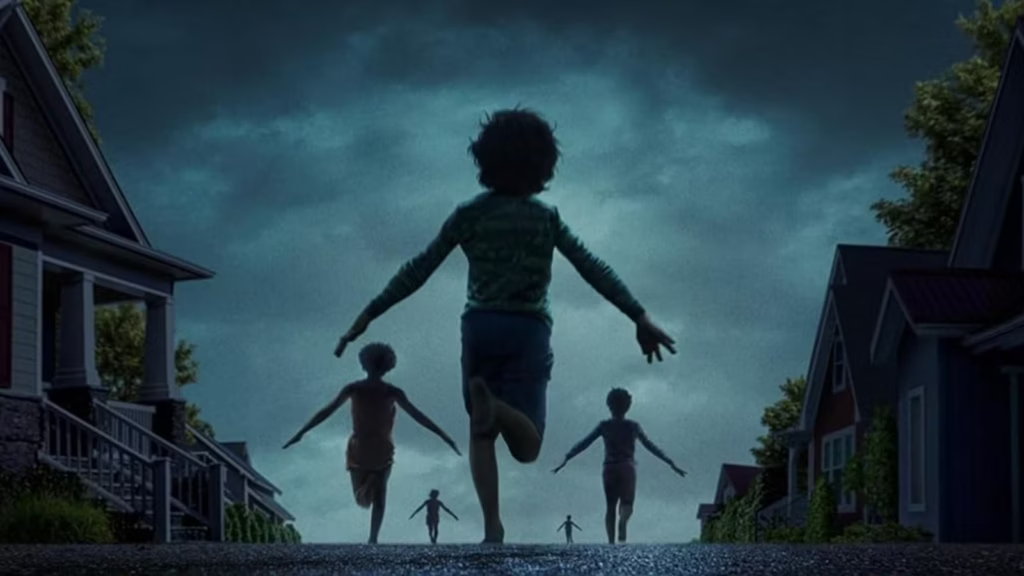
Horror has undoubtedly become the most dominant genre in modern cinema. In 2025 alone, it accounted for approximately 17% of the U.S. box office, a remarkable increase from 2.69% in 2014. Production has also increased dramatically, tripling over the previous decade, as studios increasingly rely on horror’s unique combination of low budgets, high-concept storytelling, excellent ROI, and an audience hungry for creative ideas. A big part of that momentum comes from Gen Z, who have fully embraced horror as their go-to genre and continue to show up in theaters in large numbers.
Last year, I explored the 20 best horror films of 2024, and the experience was both eye-opening and rewarding, giving me the chance to discover bold horror voices from around the world. That process was so enriching that I decided to make this an annual tradition. Similar to 2024, 2025 proved to be another landmark year for the genre. From massive hits like Sinners, Weapons, Final Destination: Bloodlines, The Conjuring: Last Rites, and 28 Years Later, to quieter standouts such as Presence, Heart Eyes, and Bring Her Back, this year delivered an embarrassment of riches. Horror dominated even in the awards circuit, with Sinners receiving a staggering 16 Academy Award nominations, giving it the most nominations of any film in Oscar history, Frankenstein receiving 9 nominations, The Ugly Sister getting 4 nominations, and Weapons receiving one nomination for best supporting actress for Amy Madigan, a rare acting nod for a horror film.
Beyond the obvious successes, this list also highlights underseen and overlooked films that deserve far more love and recognition. Spanning everything from vampire and zombie horror to body horror, slashers, supernatural horror, and horror-comedy, here are the 20 best horror films of 2025.
20. Heart Eyes – Josh Ruben

Heart Eyes, directed by Josh Ruben, manages to pull off a surprisingly fun mix of rom-com charm and slasher chaos. It’s not perfect, but its energy and entertainment value make it well worth a watch. Ally (Olivia Holt) is going through a painful breakup when her workplace forces her to partner up with coworker Jay Simmons (Mason Gooding) to save the failed Valentine’s Day marketing campaign. That night, a notorious Valentine’s Day serial killer who targets and kills couples spots them and mistakenly believes they’re together. As a result, he targets Ally and Jay and pursues them across the city, forcing the two to flee together. As the mayhem escalates, Ally and Jay must race against time to identify the killer and stop further casualties.
I was really digging the vibe of the film, especially in the first two acts. The film consists of some pretty inventive and gory kills, with the highlight being the well-executed opening sequence, which includes a romantic proposal at a picturesque Seattle winery that turns deadly when the killer murders the boyfriend, chases the woman through the winery, and finally traps and kills her inside a cylindrical wine press, setting the tone perfectly. Once the killer turns his attention to Ally and Jay, the film delivers several genuinely suspenseful set pieces. Each one traps them in tight, nerve-wracking situations where capture feels imminent. Yet, they manage to flee in creative, inventive ways that never feel repetitive—particularly the standout sequences at the police station and the drive-in, where Howard Hawks’ His Girl Friday (1940) plays while the killer tears through anybody who is in the way.
The violence is gory and horrific, but also goofy and sometimes comical (reminiscent of Sam Raimi’s films), which is not dark or agonizing to watch. The killer is also convincingly depicted, coming across as genuinely threatening and unhinged. He sports a menacing heart-eyed mask, is clad head to toe in black with a long jacket, and moves with a slow, unnerving gait made even creepier by the echo of his footsteps. His cold, efficient killing style—using knives and even a bow and arrow without a hint of remorse—only heightens his sense of danger.
On the other hand, the film competently builds a love story between Ally and Jay while they flee from the killer; their romance blossoms beautifully as the plot progresses, thanks to their electrifying chemistry and a ridiculous amount of sexual tension between them. Furthermore, the film provides both characters with enough depth to help us understand why one is commitment-phobic and avoids relationships. At the same time, the other craves a meaningful, healthy connection, giving them distinctive personalities rather than reducing them to familiar archetypes.
However, the film falters badly in its final act. Unfortunately, the killer’s reveal is both predictable and underwhelming, feeling like a lazy shortcut rather than a satisfying payoff. To make matters worse, the film never offers a convincing explanation for why he targets couples exclusively on Valentine’s Day, which further weakens the film. Despite its flaws, I still found the film fun and worth watching on the big screen. Unfortunately, it left little lasting impression, and despite having the ingredients of a rewatchable slasher, it never fully gets there. Nonetheless, it is a worthy addition to the list of the 20 best horror films of 2025.
19. Silent Night, Deadly Night – Mike Nelson

Written and directed by Mike Nelson, Silent Night, Deadly Night—the second reboot of the 1984 original and the seventh entry in the franchise—is a gleefully campy, outrageous, and gory Christmas slasher that’s wildly entertaining from start to finish. The film revolves around Bill Chapman (Rohan Campbell), who, at the age of eight, saw a man dressed as Santa Claus brutally attack his parents. This event had a profound effect on Chapman, and he went on to become a serial killer and drifter. Each Christmas, he kills bad guys while dressed as Santa, with the voice of the original attacker, Charlie (Mark Acheson), serving as a guide. When Bill arrives in the small town of Hackett, he starts working at Mr. Sims’ (David Lawrence) gift shop and falls in love with his daughter, Pam (Ruby Modine). As a string of violent occurrences afflicts the town’s residents, law enforcement and townspeople launch an investigation as the holiday season becomes more perilous.
Compared to previous installments, this one features better and more detailed characterization of the main character, Billy, whom we follow from boyhood to his journey to becoming a serial killer. And instead of portraying him as a murdering maniac, the film takes a different approach, highlighting how Billy only kills horrible people who have done terrible things in their lives, transforming him into a Vigilante anti-hero with whom we can’t help but empathize. The film has pretty good kills that are gory and brutal, especially the memorable sequence in which Billy unintentionally enters a Nazi party and decides to kill all of the Nazis (which is undoubtedly the best action in the film), blending campy absurdity with genuine tension. Furthermore, the romance between Billy and Pam adds warmth and emotional texture amid the turmoil and bloodshed. Although it isn’t always fully effective, it has its moments and ultimately does its job. Silent Night, Deadly Night is undoubtedly my favorite installment of the franchise, paying homage to its origins while appealing to current viewers seeking festive horror and chaotic slasher thrills.
18. Presence – Steven Soderbergh

Trust Steven Soderbergh to come up with something fresh every time, and he always delivers. This time, with “Presence,” he inverts the haunted-house formula, offering a fresh and genuinely intriguing take on the sub-genre. Looking for a fresh start, the Payne family—Rebekah Payne (Lucy Liu), Chris Payne (Chris Sullivan), their son Tyler Payne (Eddy Maday) and daughter Chloe Payne (Callina Liang)—move into a spacious new house to recover from a traumatic event and quickly begin to experience bizarre activities, suggesting they are not alone in the house, with Chloe noticing unsettling details before the rest of the family catches on. As the events inside the house grow more disturbing and the family’s safety—and sanity—begin to fray, the question becomes: what will it take for the Paynes to drive the presence away?
David Koepp’s screenplay takes its time (the first act) to make us realize we are watching the entire film from the ghost’s point of view, and our curiosity about the ghost’s intentions and what it wants keeps us interested in the second act. Once the film answers these questions, the third act reveals the story’s villain, culminating in a cliffhanger climax. By telling the entire story through the ghost’s point of view, the film builds a constant sense of dread and voyeuristic tension, turning even ordinary family moments into something quietly unsettling. Furthermore, family dynamics between the four members are explored in detail here, making the drama engaging and adding emotional weight to the film through strong characterization.
The household is deeply fractured, weighed down by grief, favoritism, and long-simmering resentments. Rebecca, who’s tangled up in a white-collar crime, openly favors her arrogant son Tyler, while Chris gravitates toward Chloe, who is struggling with depression and the loss of her best friend. This creates palpable tension as we watch from a distance (from the ghost’s point of view). At the same time, the camera smoothly glides throughout the home, following these characters and their movements, creating an immersive and claustrophobic experience. Instead of focusing on jump scares, the film takes its time building suspense as it deftly weaves together supernatural themes with family strife, loss, and ethical dilemmas. Presence is another low-budget, high-concept Steven Soderbergh experiment that, while it may not age particularly well once you know the story’s beats, is still worth checking out for its unconventional take on the haunted-house subgenre.
17. The Black Phone 2 – Scott Derrickson

Scott Derrickson’s The Black Phone 2 builds on the success of the first film in bold ways. I actually found it more effective than the original, thanks to its deeper emotional core, graphic brutality, heightened supernatural horror, and a broader, more ambitious scope centered firmly on its main characters. In 1982, four years after the events of the first film, Finn (Mason Thames), the only surviving victim of The Grabber (Ethan Hawke), is still trying to recover from the traumatic experience. On the other hand, his sister Gwen (Madeleine McGraw) is having disturbing nightmares about the Alpine Lake Camp in the snowy Rocky Mountains and the murders that occurred there in 1957. As a result, Gwen and Finn, along with Gwen’s friend Ernesto (Miguel Mora), travel to Alpine Camp to investigate further, where they team up with Armando (Demian Bichir), the camp supervisor. When the strange calls and disturbing events start spinning out of control, the group pieces together the truth linking the camp to The Grabber. What follows is a confrontation with a revenge-driven killer who has only grown stronger in death, set against a relentless winter storm and icy terrain.
In the original, the Grabber was killing people while alive; however, in Black Phone 2, he is still making people’s lives miserable while dead, haunting their dreams, reminiscent of the Nightmare on Elm Street movies. The film cleverly employs visual language to distinguish between dreams and reality, with the dream sequences shot on Super 8, resulting in a distinct, grainy look. Some of Gwen’s dream sequences are genuinely scary, ranging from horrifying visions of traumatized and murdered children to the nightmarish shot of a severed face still twitching behind broken glass, or the eerie memory-lane sequence where the Grabber drags her through memories tied to her mother. Furthermore, the blizzard-bound camp setting locks the characters in a cramped, isolated environment, exacerbating both claustrophobia and anxiety. The makers make excellent use of supernatural horror tropes, and with adequate development of Finn and Gwen’s characters and their family dynamics, explore themes of lingering trauma, survivor’s guilt, and the inevitability of past violence. While the film does stumble at times due to over-exposition and poor dialogue, it still delivers a richly imagined supernatural horror that genre fans will find compelling.
16. Final Destination: Bloodlines – Zach Lipovsky and Adam Stein
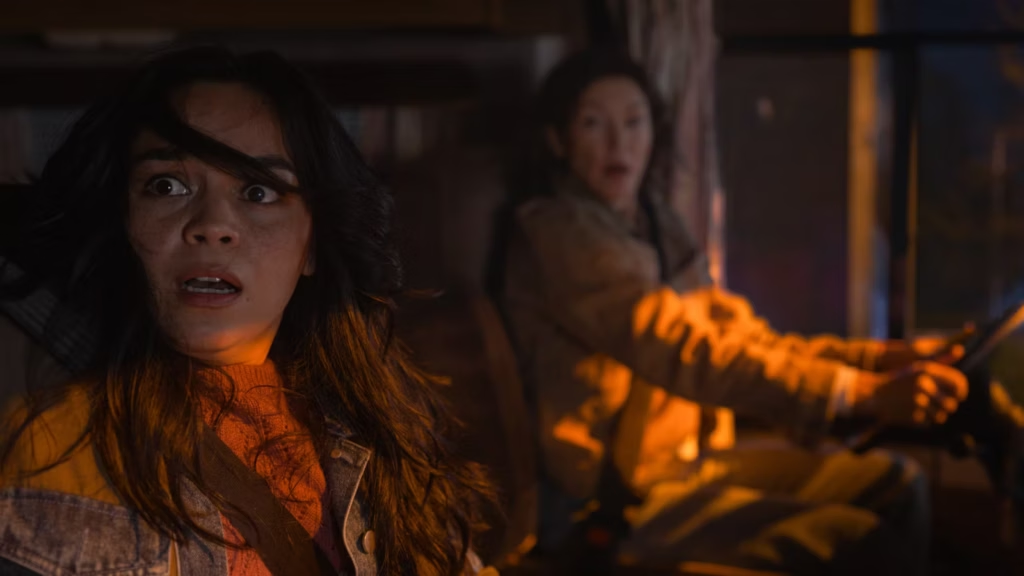
As someone who grew up with the Final Destination franchise and has always considered it a guilty pleasure, I was genuinely surprised by how much the sixth installment exceeded my expectations. Directors Zach Lipovsky and Adam Stein lean into the silliness while crafting a gleefully brutal chain of unfortunate events that consistently delivers. Stefani Reyes (Kaitlyn Santa Juana) is a college student plagued by recurring nightmares of a building collapse from the 1960s—visions that are deeply tied to her family’s past. She quickly discovers that these visions are inherited premonitions passed down from her grandmother, Iris (Brec Bassinger), who once predicted the calamity and saved several lives. Decades later, those same visions return with a darker purpose, as Stefani realizes death is coming for her family in a specific order—and she must find a way to stop it.
One of the Final Destination franchise’s trademarks is its opening sequence, and the second film’s introductory scene remains my all-time favorite. Matching that level of impact is a tough order, but this installment pulls it off with conviction and perfection. From Iris and her boyfriend Paul’s arrival outside the building to the impending disaster that unfolds once they reach the top of the Sky View restaurant tower, the entire opening sequence set in 1969 is packed with tension and unease. Through a barrage of close-ups, off-kilter camera work, and unnerving sound effects, the filmmakers create a constant sense of anxiety, pulling you into the slow, dreadful buildup toward the inevitable catastrophe. Aside from the ingeniously directed opening sequence, the film delivers some memorable death sequences and grisly set pieces that are cleverly designed and exceptionally executed, such as the sequence in the tattoo parlor, the one in the hospital involving an MRI machine that malfunctions and becomes highly magnetic, or the one on the streets involving a garbage truck, a football, and a leaf blower.
Furthermore, the film is unexpectedly profound, with decent characterization and an examination of Reyes’ familial dynamics, such as Stefani’s relationship with her estranged mother, Darlene, and the brother-sister bond between Stefani and Charlie, giving the film a stronger emotional impact than expected. The film explores themes of generational trauma and the impossibility of outrunning fate, while also highlighting the importance of family reconciliation in the face of inevitable mortality. And a special mention to Tony Todd in his final screen appearance as JB, the series regular, who was dying while shooting this film, but his monologue (which he improvised) is easily the film’s best scene, adding depth to its themes as well as poignant gravitas and a fitting end to his commendable on-screen career. Directors Zach Lipovsky and Adam Stein breathe new life into the final destination franchise, and I’m excited to see what demented ways of dying they come up with in the next installment.
15. The Wailing – Pedro Martin-Calero

Pedro Martin Calero makes his Spanish feature debut with The Wailing, an assured, chilling, and richly atmospheric psychological horror film. In present-day Madrid, a young college student named Andrea (Ester Expósito) begins to sense a strange presence following her after she hears a faint, distant cry while walking through a building. Twenty years earlier, a free-spirited young woman named Maria (Mathilde Ollivier) encounters the same haunting presence while living in Argentina. Meanwhile, an aspiring filmmaker, Camila (Malena Villa), becomes drawn to Maria and quietly follows her with a camera, and starts secretly filming her for a short film project. She befriends Maria, discovers her turbulent past, and attempts to make sense of the weird happenings that surround her. As the film progresses, all three women find themselves bound by the same disturbing occurrence, which they strive to comprehend and overcome.
The film can be classified as “elevated horror,” building its sense of dread through mood and atmosphere rather than leaning on cheap jump scares. Through careful framing and slow camera movements, makers ensure a lingering sense of danger hovering over the women, as claustrophobic settings and polished visuals work together to create a quietly uneasy atmosphere. The film’s slow, deliberate pacing draws you in, letting paranoia and discomfort slowly take hold. The entity’s enigmatic nature maintains your curiosity and intrigue, and although the revelation is not entirely shocking, it is still profoundly unsettling and difficult to forget.
The film works as a powerful allegory for men’s violence against women, whether sexual or physical abuse, as the entity represents the unavoidable threat women face, which is often rooted in patriarchal structures. Also, the fact that the entity only follows and haunts one generation of women (Andrea and her biological mother, Marie) delves into generational trauma, examining how abuse and its consequences are passed down from generation to generation, affecting not only direct victims but those around them. Finally, people surrounding Andrea and Marie not believing in them reflects a harsh reality: victims are constantly doubted, blamed, and ostracized, creating a cycle that can lead to insanity and long-term misery. The Wailing is an unnerving viewing experience worthy of inclusion on the list.
14. Companion – Drew Hancock

Drew Hancock’s directorial debut, Companion, produced by Zack Creggar (who was supposed to direct this film after Barbarian (2022)), is a sharp, twisted sci-fi horror that cleverly blends horror, dark comedy, and relationship satire, emerging as one of the most entertaining surprises of early 2025. Iris (Sophie Thatcher) and Josh (Jack Quaid) have been inseparable and deeply in love since they first met in a supermarket. They decide to spend the weekend at a remote lake house with Josh’s friends, including Kat (Megan Suri), Eli (Harvey Guillén), and his partner Patrick (Lukas Gage), and Kat’s intimidating boyfriend Sergey (Rupert Friend), who owns the house. However, what begins as harmless fun quickly descends into chaos when one of them is found dead in a pool of blood, forcing each character to react as Iris’s secrets surface and the night spirals out of control, turning their carefree getaway into a fight for survival.
The film unfolds in three distinct acts, each culminating in a shocking, explosive reveal. The first act delves into Iris and Josh’s relationship dynamics, introduces Josh’s friend circle, and concludes with Iris killing Sergey, revealing her true nature as a companion robot. In the second act, the storyline shifts into a suspenseful survival thriller as Iris runs for her life, revealing Josh and Kat’s ingenious scheme and establishing Josh as the film’s true villain. The act ends with Iris getting caught and committing suicide, leaving audiences to wonder whether Josh will succeed in his criminal plot or if Iris would still fulfill her destiny that was alluded to in the opening scene. By portraying Iris as a robot, the film delves into the topics of misogyny and power imbalance, reflecting the hardships of toxic relationships and the disturbing mindset associated with incel culture (via Josh’s character, who epitomizes the perfect archetypal incel figure).
Josh Breeman embodies the incel archetype, viewing himself as a good-hearted person deserving of love and acceptance while blaming the world for his failures. His need for control becomes clear in the way he programs Iris, reducing her emotionally and intellectually, so she exists only to please him—an attempt to sidestep rejection and the give-and-take that real relationships require. Sophie Thatcher gives a star-making performance as Iris, transitioning from a naïve, devoted companion robot into a fierce and formidable presence with chilling conviction. At the same time, Quaid excels as the deceptively charming boyfriend, repurposing his “The Boys” charisma into something deeply disturbing. Clocking in at just 97 minutes, the film moves at a brisk pace, never wears out its welcome, and delivers a fresh, bloody good time at the movies.
13. Together – Michael Shanks

In his directorial debut, Michael Shanks delivers a gory and gripping horror film, Together, skillfully blending elements of body horror with genuine emotional depth. Tim (Dave Franco) and Millie (Allison Brie) are a long-time couple who relocate to the countryside to begin a new chapter of their lives after Millie accepts a new position as a school teacher. While on a hike one day, they stumble into a pit, where they spend the night and also drink water from a mysterious pool. Following that, strange occurrences begin to unfold, with mysterious forces affecting them in bizarre physical ways, forcing them to question their relationship and what they thought they knew about themselves and each other.
Although the film’s plot is predictable and its final act feels rushed, it remains an intriguing watch thanks to its body horror elements and the complex dynamics between Tim and Millie. There are some truly grotesque and gory body horror elements, such as a scene where Tim and Millie’s genitalia become stuck during intercourse, another where their arms fuse and Millie uses a saw to cut them apart, and finally a scene where their bodies are totally fused. Furthermore, the dynamic between Tim and Millie feels layered and distinctly modern, shaped by emotional distance, physical stagnation, and quiet resentments that linger just beneath the surface.
What really grounds the film is the chemistry between the real-life couple Brie and Franco. It doesn’t feel performative; it feels lived through and authentic. That makes the body horror more than spectacle—it makes it hurt. Beneath all the body horror, the film is really about codependency—about how two people can slowly lose themselves in each other until they don’t quite know who they are alone. The literal merging of their bodies isn’t subtle, but it works. It turns “you complete me” into something suffocating and terrifying. While the mythology surrounding the pit and the well feels only partially explored, the film’s honest take on intimacy, fear of being alone, and the messy reality of love is what really holds it together.
12. Best Wishes to All – Yūta Shimotsu

Inspired by the iconic J-horror films of the ’90s and 2000s (which I have discussed in detail in the list of best Japanese horror films), Best Wishes to All is a high-concept, deeply unsettling slow-burn horror and a confident first feature from director Yūta Shimotsu. The film follows a young nursing student (Kotone Furukawa) who heads back to her grandparents’ rural home to get away from the noise of city life. At first, it’s peaceful. They seem happy to see her—maybe even overly thrilled. But little by little, something starts to feel off as their actions grow increasingly strange and her sense of comfort starts to slip. As she digs deeper, she starts to sense that the entire town is acting strangely, and with the help of her childhood friend (Kôya Matsudai), her search for answers pulls her into a dark, disturbing web of secrets that slowly turns her once-happy routine into a waking nightmare.
The film introduces the nursing student as someone with infectious optimism and a sincere desire to help others. As she travels from Tokyo to a tranquil rural community, the film gradually develops tension, employing sweeping, long shots and an eerie score to suggest that something very terrible lurks beneath the gorgeous surroundings. At first, the grandparents are warm and welcoming; they seem like lively, positive people. However, she soon discovers that beneath their cheerful exterior, they exhibit strange behavior (psychotic, to say the least) that appears out of nowhere. Some of the film’s most unsettling moments come from its odd, unexplained behavior, like the grandparents abruptly oinking together at the dinner table with no explanation, the grandfather standing frozen and staring blankly at the ceiling, mouth agape, and the grandmother standing in a dark hallway, rushing forward and violently pounding on a door.
One of the most shocking scenes occurs in the midst of an ordinary breakfast. Out of nowhere, a man crawls into the kitchen—his eyes and mouth crudely sewn shut. It’s horrifying enough on its own, but the real gut punch comes when the girl realizes the truth: her grandparents have kidnapped him, are torturing him, and even eating his flesh. When her parents arrive, and she tells them what’s happening, their lack of surprise makes it even worse: they already know and are part of it. Soon, she understands this isn’t just her family—nearly everyone in town follows the same ritual, except for her lone friend, the only person who seems genuinely unhappy. The third act then focuses on how she processes this truth and decides what she’s going to do next. Rather than relying on jump scares, Shimotsu lets the tension simmer, using uncanny visuals, long stretches of silence, and a creeping unease to get under your skin.
The film isn’t just trying to shock. Beneath the horror, it’s wrestling with uncomfortable themes—exploitation, the kind of loneliness that creeps in with age, and a society that builds comfort for some on the suffering of others. It highlights a disturbing emotional detachment in modern society, where cruelty is normalized—seen most clearly in the way the family revels in the man’s torture and no one seems troubled by the violence, viewing him merely as a sacrificial offering. “Best Wishes to All” is a stomach-churning, thought-provoking treat for fans of intelligent, disturbing horror.
11. It Ends – Alexander Ullom

Alexander Ullom makes an outstanding directorial debut with It Ends, transforming a deceptively simple premise into a gripping existential horror experience. The story follows four recent college grads — James (Phinehas Yoon), Day (Akira Jackson), Fisher (Noah Toth), and Tyler (Mitchell Cole) — who head out for what’s supposed to be a carefree late-night drive. At first, it feels harmless. Then the road just doesn’t end. No exits. No turns. Just the same two-lane stretch of highway repeating itself. And whenever they stop the car, people come running out of the woods, frantic, desperate, begging for help—or trying to take their car. To survive, they must figure out how to get off this terrifying two-lane road, which is riddled with unseen horrors and cosmic forces beyond their comprehension.
Alexander Ullom uses a seemingly simple road trip setup and gradually turns it into something far more terrifying. What begins as a familiar idea evolves into a silent, creeping horror that resonates powerfully with Gen Z’s anxieties. The car’s claustrophobic setting enhances the performances, transforming casual conversation into something profoundly unsettling as the characters grapple with the existential issues plaguing them. As the story unfolds, we learn more about the characters—their vulnerabilities, fears, and the subtle tensions that exist between them.
The endless road becomes more than a trap. It feels like a metaphor for life where you’re moving but not really getting anywhere. Each of them handles it differently. Tyler checks out completely, almost choosing denial over reality. Fisher and Day go in the opposite direction, settling into it and convincing themselves this is just how things are. James can’t do that. He keeps searching for answers, for logic, for some crack in the system. What I appreciate is that the film doesn’t mock any of them. It understands that when you’re faced with uncertainty, people cope in different ways. And by the end, it quietly suggests that maybe life isn’t about escaping the road—it’s about who’s in the car with you. The film’s taut screenplay doesn’t waste time and stays gripping throughout. It keeps moving, keeps tightening the knot. And when it ends, it doesn’t offer comfort or clarity—just questions. The kind you find yourself turning over in your mind days later.
10. Strange Harvest – Stuart Ortiz

Strange Harvest is a creepy, gruesome, and downright diabolical mockumentary horror film—and a bold, fearless debut from director Stuart Ortiz that’s definitely not for the faint of heart. Set in Southern California’s Inland Empire, the film follows detectives Joe Kirby (Peter Zizzo) and Lexi Taylor (Terri Apple) as they look back on their decades-long hunt for Mr. Shiny (Jessee Clarkson), a serial killer responsible for a string of grisly, ceremonial murders. What initially appears to be unrelated homicides begins to form a pattern, revealing a new wave of hideous, otherworldly crimes linked to a dark cosmic force. Through interviews, case files, and reconstructed scenes, the detectives slowly piece together the timeline of the murders and how the investigation into apprehending Mr. Shiny grew more far-reaching over time.
The film’s true-crime presentation is so convincing that it genuinely feels real. Between the interviews, archival-style webcam and body-cam footage that evoke the ’90s and early 2000s, and the detailed crime scene recreations, I was completely sold on the idea that this was an actual case. Only after watching the film and reading about it did I realize it was a completely fictional story. The film follows the generic screenplay structure of a serial killer film, beginning with murders, police investigations, and the pursuit of the killer. What sets the film apart is the way it presents its killings—graphic, nightmarish, and designed to get under your skin, with some images refusing to fade from memory. The procedural side of the film is just as effective, following police who are essentially chasing a ghost—a killer with no job history, no criminal record, and no financial trail. Each new lead opens the door to unsettling discoveries about who he might be, piquing the viewer’s interest. The film also spends time unpacking the killer’s motivations, and that’s where it truly crosses into horror territory. The murders are rooted in ritual and occult practices, and by the time the film reaches its finale, it fully embraces the supernatural—yet it all feels plausible rather than far-fetched.
In addition, his methods and the brutality on display here make the killer in the film possibly the most dangerous and sinister serial killer in movie history. He is even more malevolent and evil than Kevin Spacey’s killer in Se7en (1995) or the Zodiac killer in Zodiac (2007). On the other hand, the occult elements feel rushed, underexplored, and undercooked, which detracts from the film’s final act and prevents it from reaching the heights it deserves. Nonetheless, Strange Harvest is a solid, clever, and stomach-churning horror film that lingers uncomfortably, making it an ideal watch for fans of Zodiac (2007), Lake Mungo (2008), and The Blair Witch Project (1999).
9. Exit 8 – Genki Kawamura

Based on the 2023 video game of the same name, Exit 8, directed by Genki Kawamura, is a low-budget, tightly constructed psychological horror that keeps you on edge and stands out as one of the year’s most unique films. A man known only as the Lost Man (Kazunari Ninomiya) becomes trapped in a maze-like subway tunnel, surrounded by endless, repeating corridors with no obvious escape. The only way out is to identify an anomaly in the pathway. The rules are simple but unforgiving: see an anomaly and turn back, see nothing and keep walking. He has to repeat this process again and again to make his way from Exit 8 to Exit 0 (the final escape). But a single oversight will send him back to the beginning. Along the way, he repeatedly crosses paths with the silent Walking Man (Yamato Kochi), while also encountering the Boy (Naru Asanuma) and the High School Girl (Kotone Hanase), all within a looping, ever-shifting maze. The question remains: will he escape the interminable corridor?
Exit 8 has an intriguing premise that unfolds entirely within a never-ending corridor, where the Lost Man becomes trapped and must search for anomalies to move forward. And that’s not an easy task. We want him to succeed and spot the anomalies to see what happens next, and we sometimes spot them before he does. The filmmakers make the corridor so familiar that I caught myself yelling at the screen when he missed an anomaly, frustrated to see him forced to reset again. As the Lost Man moves deeper into each level, the film becomes increasingly uncomfortable, leaning into psychological horror—the kind that messes with your head—and then slowly pushes into darker, more graphic territory. Soon, new characters enter the picture, perspectives begin to shift, and the focus moves from the Lost Man to the Walking Man he encounters every time he enters the Exit 8 corridor, and then to a boy who suddenly appears, lost and out of place, making the puzzle even more compelling. The film’s stripped-down visuals—clinical white tiles, harsh fluorescent lighting, and precise framing—create an uneasy, boxed-in feeling, relying on quiet dread rather than jump scare tactics.
We get a clearer picture of the Lost Man as a person when we learn that he has a girlfriend who informs him that she is pregnant—and that he has no idea whether he’s ready to become a father. Additionally, the film’s opening sequence helps define his character. On the metro, he witnesses a man yelling at a woman over her crying baby, and instead of intervening, he does what everyone else does—slips on his headphones and looks away. Through its minimalistic filmmaking style, the film explores guilt, regret, and emotional paralysis, ultimately reminding us that being human means making choices and taking risks—even when the outcome is uncertain. It’s also about people who acknowledge their own flaws and express a desire to change, but freeze when the moment actually arrives and lack the courage to follow through.
8. Dust Bunny – Bryan Fuller

Bryan Fuller, the creative force behind Hannibal and Star Trek: Discovery, makes a confident leap into feature filmmaking with Dust Bunny, delivering a visually dazzling and wildly imaginative debut that feels refreshingly original and primed for cult status. The film follows eight-year-old Aurora (Sophie Sloan), a New York City kid convinced there’s a monster living under her bed. When her parents suddenly vanish, she’s certain the monster is responsible. Desperate to stop it, she turns to her mysterious neighbor, the resident of 5B (Mads Mikkelsen), a hitman she hires to kill the creature. Convinced that her parents were killed by the assassins pursuing him, he contacts his handler, Laverne (Sigourney Weaver), and informs her that it is his obligation to protect her. Thrown together by circumstance, they lean on each other to confront both real-world threats and the terrifying possibility that Aurora’s monster isn’t just in her head.
By fusing creature-feature horror, assassin-driven action, surreal fantasy, and dark humor, the film carves out a tone that’s both distinctive and surprisingly delightful. The relationship between Aurora and the resident of 5B is one of the film’s biggest strengths. Their dynamic feels easy and authentic, elevating the emotional beats around protection and chosen family. Aurora’s blunt determination contrasts nicely with 5B’s calm, deadpan demeanor, made even more memorable by his strange, retro wardrobe that feels straight out of the 1970s. The screenplay does a wonderful job of casting doubt regarding the existence of a monster. On one level, the story invites us to see things through Aurora’s eyes, where a hidden monster is responsible for the disappearance of her foster parents. On the other hand, a more grounded explanation suggests they may have been victims of assassins targeting the resident of 5B instead. However, the film falls short of fully exploring Aurora’s turbulent past, mentioning it only in passing through exposition as an information dump rather than delving further visually, leaving big questions unanswered—why her biological parents abandoned her, and whether all of her foster homes were abusive, neglectful, or simply unwilling to listen.
Through the eyes of Aurora, a girl who sees monsters, the film delves into the topics of childhood trauma, shedding light on how children cope with emotional abandonment, abuse, loss, and grief through their imagination. The monster serves as a powerful metaphor in the film, translating unresolved emotional pain into something concrete and visible—a representation of the fears we repress until they demand our attention. By the end, Aurora realizes that the childhood trauma will never go away and will always be a part of her identity, which she must learn to live with.
From the very first scene, the film unfolds as a visual feast, shaped by Fuller’s signature decayed pastels, elegant camera work, and carefully balanced compositions that immerse you in its world. By the time the third act rolls around, the film finds another gear. The introduction of new characters shakes things up, and David Dastmalchian’s assassin—slick, reckless, and a little too confident—is a blast to watch. From there, everything snowballs into a finale that’s big, chaotic, and wildly entertaining—but still lands with surprising emotional weight. Dust Bunny feels like a love letter to classic genre cinema, drawing from classics like Léon: The Professional (1994) in the unlikely bond between Aurora and the resident of 5B, The City of the Lost Children (1995) in its fairy-tale surrealism, Tremors (1990) with its underground monster, and Gremlins (1984) in its cute-but-creepy creature and playful, gory fun. If you love that mix, Dust Bunny is absolutely your jam.
7. 28 Years Later – Danny Boyle

After the first two installments earned cult status, Danny Boyle and Alex Garland reunite 18 years later for 28 Years Later. Rather than catering to fan expectations, they push the franchise in unexpected directions and instead swing for something bolder and more experimental. It’s an uneven but fascinating film—one that may frustrate some viewers, but personally, I admired its ambition and found it both visceral and emotionally resonant. Following the initial breakout of the rage virus in 28 Days Later (2002), Britain remains unrecognizable, but some have found a means to survive amidst the infected. One such group of survivors lives on a small island linked to the mainland by a single, heavily fortified causeway. On the island, Jamie (Aaron Taylor-Johnson), a fearless scavenger, must take his 12-year-old son, Spikey (Alfie Williams), to the infected mainland for a coming-of-age hunting ritual, despite the wishes of Spikey’s sick, bedridden mother, Isla (Jodie Comer), who suffers from a mentally debilitating weakness. After surviving the test and fighting off several newly evolved types of zombies, Spikey returns home and learns about a doctor named Dr. Kelson (Ralph Fiennes) living on the mainland. Hoping for a cure, he takes his mother there, desperate to save her. With every mile deeper into the mainland, the journey grows more treacherous and survival more uncertain.
The film really feels like a tale of two halves, with the first leaning heavily into fan service—especially once Spikey and Jamie leave their isolated island and venture into mainland Britain for Spikey’s coming-of-age hunting ritual. The entire zombie hunt is superbly staged, with high-stakes action setpieces fueled by the appearance of various wild zombie types, such as slow-moving, overweight zombies, fast-running zombies, and the enormous, intelligent alphas who can yank a person’s head off their spine. Using his signature kinetic style of filmmaking, Boyle incorporates fast-paced action sequences with eye-catching graphics that depict both the eerie beauty of forested settings and moments of pure terror.
The second half begins another adventure, this time with Spikey taking Isla to mainland Britain to visit Dr. Kelson in the hopes of treating his dying mother. The story gradually shifts away from being just another zombie adventure. It evolves into a coming-of-age tale for Spikey, centered on his bond with his mother and deeper themes of survival, fear, and mortality—subverting expectations of a typical sequel. It contains fewer anxiety-inducing moments and tense action set pieces (though the entire train sequence in which a pregnant zombie mother gives birth was absolutely insane), and concentrates more on the characters, particularly Dr. Kelson, who adds a little more flair and flavor to the plot.
Additionally, Kelson’s embrace of memento mori (the inevitability of death) is a thoughtful touch as the bone temple isn’t just a macabre decoration. It’s his way of making peace with death, of refusing to let the dead be forgotten. By honoring the dead, both the living and the infected (who were human once), the film finds something tender amidst all the devastation. It’s a small touch, but it carries plenty of emotional weight.
The film clearly has Brexit on its mind. There’s a thread running through it about British isolationism and this uneasy sense of cultural decline. The quarantined island feels like a country trying to rebuild itself while clinging to some romantic idea of what it used to be. That said, it doesn’t all land. The final stretch feels strangely out of sync, especially when those tracksuit-wearing thugs with gold chains and stark white bob haircuts show up out of nowhere. A few stylistic choices don’t quite land either—the odd music cues and those repetitive freeze-frame zombie kills feel more distracting than effective. Still, even with its rough edges, the film is bold and ambitious. It’s polarizing and imperfect, but it worked for me.
6. Dead Talents Society – John Hsu

Dead Talents Society, directed by John Hsu, is wildly original, laugh-out-loud funny, and surprisingly heartfelt—easily one of the best feel-good horror comedies I’ve seen in years and the biggest pleasant surprise while putting this list of best horror films of 2025 together. The film revolves around The Rookie (Gingle Wang), a recently deceased girl who enters a surreal afterlife and must devise a method of scaring humans within 30 days or risk vanishing completely. She’s soon recruited by Makato (Chen Bolin), a lively, fast-talking agent who also represents the legendary phantom diva Catherine (Sandrine Pinna). That pulls her into a fiercely competitive ghost world, where spirits like Jessica (Eleven Yao) (Catherine’s former protégé turned rival) and others battle for fame, all chasing legendary status as elite haunters. The question is: can this rookie prove she belongs?
Most horror films focus on ghosts crossing into the human world to scare people for something specific that they want (revenge, justice, or closure). John Tsu flips that idea on its head by asking what life looks like on the other side. The result is a wonderfully imagined ghost underworld where spirits behave like ordinary people, and scaring humans is treated as a performance art. The more creative and effective your scares, the more recognition and rewards you earn, including the acquisition of a haunting license that lets you stay in that world. You’ve got Cathy, who haunts people the old-school way in a hotel setting, while her protégé-turned-rival Jessica embraces modern methods, using the internet to terrorize people. Things get interesting when Makato recruits a non-talented rookie and her best friend from the Dead Talents society, which also includes technician Kouji. The group has 30 days to create an effective scaring method for the rookie and obtain a haunting license before she disintegrates and vanishes. As a result, the group experiments with various scaring methods, resulting in several laugh-out-loud moments. Along the way, they grow closer, forming a found-family bond that feels genuinely warm and becomes the emotional heart of the film.
The rookie’s arc becomes a way for the film to explore questions of identity and modern anxiety, especially for Gen Z. It emphasizes that you don’t have to force yourself to be extraordinary to matter—real fulfillment comes from self-acceptance and owning who you are, a message that resonates in a world obsessed with uniqueness, personal branding, and influencer culture. Gingle Wong delivers an excellent performance as the rookie, a confused adult who considers herself a loser and not good at anything. Her journey toward self-acceptance and coming of age feels genuinely heartfelt, relatable, and deeply touching. Dead Talents Society is full of playful vibes, zany slapstick humor, a cleverly written plot, and endearing characters, making it one hell of a fun ride.
5. The Ugly Stepsister – Emilie Blitchfeldt

The Ugly Stepsister, the debut feature film by Norwegian filmmaker Emilie Blichfeldt, subverts the traditional Cinderella story in a daring and disturbing way. At the center is Elvira (Lea Myren), a tender, romantic soul who wants nothing more than to be loved—even as she carries the quiet sting of knowing she doesn’t fit the world’s idea of beauty. She lives with her sharp, scheming mother, Rebekka (Ane Dahl Torp), and her younger sister, Alma (Flo Fagerli). After Rebekka’s rich husband dies and leaves them nearly broke, the family finds itself trapped between dwindling money and even fewer choices. By contrast, Elvira’s stepsister Agnes (Thea Sofie Loch Naess) is effortlessly beautiful, the kind of presence that turns heads the moment she enters a room. It isn’t long before Prince Julian (Isac Calmroth) is drawn to her, stirring deep jealousy in Elvira, who has dreamed of marrying the Prince since childhood—ironically, the very match Rebekka is determined to arrange to rescue the family from financial ruin. As a result, Elvira embarks on a deeply uncomfortable journey in which she tries to reinvent herself as someone worthy of the Prince’s attention. Encouraged by her mother, she goes to increasingly extreme lengths to change her appearance and win his affection, only to discover that those choices come at a terrible cost.
What begins as a sumptuous, corseted period drama quickly curdles into something far more grotesque—a relentless body-horror nightmare filled with extreme close-ups of popped zits, writhing maggots, severed toes, shattered noses, tapeworms, and acts of self-mutilation, all driven by a warped obsession with achieving “perfect” female beauty. Marcel Zyskind’s cinematography effortlessly pulls us into the 19th century, bathing the film in a gothic mood while also finding beauty in softer, almost fairy-tale imagery—sunlit forests, misty glens, looming castles, and open countryside.
Blichfeldt directs with skill and elegance, juxtaposing tender, graceful scenes with moments of brutal shock that help sharpen the film’s feminist critique of patriarchal beauty norms. The Ugly Stepsister (2025) feels uncomfortably timely in an age of Ozempic and cosmetic quick fixes, revealing how little the underlying violence of beauty standards has actually changed—only how well it’s been repackaged. Lea Myren goes all in, delivering a bold performance that balances genuine pathos with flashes of absurdity as Elvira’s fixation slowly tears her apart. The film would make a strong double feature with Coralie Fargeat’s The Substance, since both explore how societal pressure turns the pursuit of beauty into physical punishment. Still, The Ugly Stepsister feels more raw and volatile, pushing its anger and ugliness further than its counterpart.
4. Bring Her Back – Michael Philippou and Danny Philippou

With Bring Her Back, the Australian directorial duo Michael and Danny Philippou deliver a chilling, emotionally devastating supernatural folk-horror film that serves as a terrific follow-up to their debut, Talk to Me (2022), and cements them as one of the strongest modern voices in the horror genre. Following the unexpected death of their father, 17-year-old Andy (Billy Barratt) and his visually challenged stepsister Piper (Sora Wong) are placed in the care of Laura (Sally Hawkins), their new foster mother, who lives with a non-speaking foster kid named Oliver (Jonah Wren Phillips). Andy will be able to assume custody of Piper and be her primary caregiver once he turns eighteen. Until then, the siblings must remain with Laura for another three months. At first glance, Laura appears to be a fun, carefree woman. However, Andy quickly notices something strange about her and starts to realize that she is up to something evil. As unsettling and inexplicable things begin happening around them, the siblings must navigate their increasingly uneasy foster home with a growing sense of urgency.
What impressed me most was how controlled the pacing of the script feels. It knows when to pull back and when to press harder. When Andy and Piper move in with Laura, the unease creeps in bit by bit. Oliver’s behavior is disturbing on a visceral level, Laura’s rituals grow increasingly ominous, and her quiet attempts to separate the siblings create a mounting sense of dread. The film makes you sit with those questions, letting the tension build until the final act hits with real emotional force. When everything finally unravels, the ending feels earned—tense, heartbreaking, and shaped by very human themes of grief and trauma. What starts as a grounded family drama gradually turns into a grief-soaked nightmare of ritual, madness, and body horror. The Philippous balance slow-burning tension with brutal, unforgettable shocks, blending wince-worthy violence with imagery that leaves a lasting impression.
Sally Hawkins delivers a tour-de-force performance as Laura, a woman whose grief transforms her from a caring person to someone who is terrifyingly unstable. It’s a standout turn that went undeservedly unnoticed by awards bodies this year. Additionally, Billy Barratt as Andy and Sara Wong as Piper are remarkable as siblings, and their natural, organic connection—rooted in genuine love and care for one another—forms the emotional core of the film, making us both terrified for them and deeply invested in their survival. Bring Her Back is not for the faint-hearted—a deeply harrowing horror film that cuts deep and sticks with you for days after it’s over.
3. Frankenstein – Guillermo del Toro
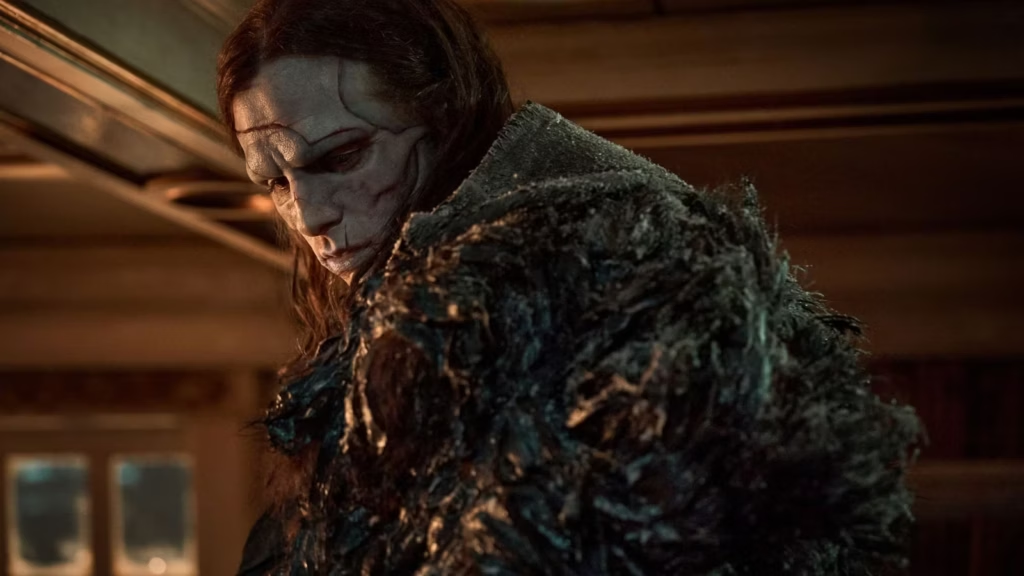
Guillermo del Toro’s extravagant, artistically stunning science-fiction gothic horror epic, Frankenstein, is the most authentic adaptation of Mary Shelley’s 1818 classic, capturing the spirit of the story’s fundamental tragedy while infusing Del Toro’s signature fairy-tale and body-horror elements. Victor Frankenstein (Oscar Isaac) is a genius scientist motivated by vanity and ambition, determined to bring life from the dead at any cost. With funding from industrialist Henrich Harlander (Christoph Waltz), he finally does the impossible and brings life back from the dead. The creature he creates (Jacob Elordi) is extremely powerful, has rapid self-healing abilities, and is immortal. Victor’s obsession doesn’t just change science; it fractures his relationships with his younger brother William (Felix Kammerer) and Elizabeth (Mia Goth), William’s fiancée. Realizing that the creature is not developing intellectually, Victor decides to abandon him and try to kill him, concluding that the experiment was a failure. The creature, however, doesn’t die. He endures—and in the loneliness of the wilderness, that rejection becomes the foundation of who he will become.
Rather than relying on the familiar mad scientist trope, del Toro focuses on Victor and the Creature’s relationship, exploring themes of failed fatherhood, forgiveness, and the value of understanding and actually listening to one another. The screenplay takes its time delving into Victor’s character, showcasing his narcissism, intelligence, and obsession with finding a scientific cure for death. His relationship with his father casts a long shadow, and when he rejects the creature, it’s hard not to see the pattern. He can create life, but he can’t nurture it. And that’s where the real tragedy lies. The extended section in which Victor, aided by Harlander, builds his laboratory from scratch and carries out his experiments is particularly engaging and fascinating to watch.
Additionally, a significant portion of the film is devoted to delving into the creature’s personality. In del Toro’s hands, he is not a monster at all. He’s a compassionate yet lethal, tragic human soul, capable of pain and loneliness, and burdened with immortality that denies him the release most humans are granted. The extended sequence between him and the blind patriarch, who teaches him to read and speak, deepens his character and is unexpectedly tender and sharply edited, never once slowing the film’s momentum, even though it easily could have. With Frankenstein, del Toro fully embraces his signature gothic grandeur—lavish sets, shadow-soaked Victorian laboratories, and a creature design that’s both grotesque and poignant. The richly moody color palette and fully constructed sets give the film a tangible, immersive feel that digital backdrops can’t replicate.
Jacob Elordi is genuinely heartbreaking here. His creature isn’t some growling villain—he’s emotionally wounded, lonely, desperate to be understood. The sadness in his eyes does more than any special effect could. He makes the character feel painfully human.
2. Weapons – Zach Cregger

Following the breakout success of Barbarian (2022), Zack Cregger returns with Weapons, a film that’s not only frightening but thrillingly unpredictable and deeply satisfying, cementing him as one of the most original and inventive voices working in horror today. On the morning of February 17th, in the tranquil Pennsylvania town of Maybrook, all but one of the seventeen students enrolled in teacher Justine Gandy’s class—Alex Lilly (Cary Christopher)—disappear from their homes precisely at 2:17 AM. While the town tries to make sense of what happened, Archer Graff (Josh Brolin), a grieving parent, is unraveling. He doesn’t trust the police’s investigation or their reassurances. So he takes matters into his own hands and begins to investigate, initially focusing his suspicion on Justine. Elsewhere, James (Austin Abrams), a homeless drug addict, stumbles onto disturbing clues connected to the missing children. As their paths cross, shocking truths about Alex’s family, notably his aunt Gladys (Amy Madigan), emerge, plunging the town into chaos and transforming a missing-person investigation into something darker, stranger, and far more dangerous for the town.
The film’s non-linear structure and shifting points of view make the story far more engaging, while also giving each character the space to grow. By spending time with these people, the screenplay adds depth and nuance, pushing the characters beyond familiar horror archetypes. The cinematography feels playful yet hauntingly immersive, the sound design steadily builds unease, and the film swings effortlessly from creepy to funny to downright terrifying without missing a beat. The film explores several themes through its horror-mystery framework, refusing to spoon-feed the audience and instead encouraging deeper discussion and analysis of what Cregger is trying to say. Starting with the simple premise of 17 missing children, Creggar examines guilt and how it destroys families, revealing survival guilt and unadulterated loss.
Addiction emerges as one of the film’s most striking themes, influenced in part by Cregger’s own upbringing in an alcoholic home. Several characters in the film face the challenge of addiction—Justine resorts to drinking as a coping mechanism, Paul is a recovering alcoholic who relapses, and James is a drug addict dismissed by society. Through them, the film shows how addiction is deeply self-destructive, creating ripple effects that harm everyone in its path. Furthermore, Aunt Gladys becomes a chilling metaphor for that idea, literally draining the life from the young to grow stronger, hijacking free will through triggers, and turning people into weapons. Her presence leaves Alex alone in a home stripped of safety and love, echoing the emotional fallout of Cregger’s own childhood. Impressive performances anchor the chaos: Garner captivates with her subtle desperation, Brolin brings a tired intensity, Austin Abrams is authentic as a drug addict and delivers several hilarious moments, and Amy Madigan delivers a career-best performance as the sinister Aunt Gladys.
1. Sinners – Ryan Coogler

Sinners, directed by Ryan Coogler, is an audacious and singular Southern Gothic horror experience—transformative on the big screen and staggering in its ambition and visual power. Few films in recent years have made me feel this alive, and it’s easily the best horror film of 2025. Set in 1932 in the Mississippi Delta, the film follows twins Smoke and Stack (Michael Jordan), two criminals who return to their hometown from Chicago (where they worked for Al Capone) with the goal of opening a juke joint for the community. As a result, they hire their cousin Sammie Moore (Miles Caton) as a performer/musician, Smoke’s estranged wife Annie (Wunmi Mosaku) as a cook, Delta Slim (Delroy Lindo) as a pianist, Bo Chow (Yao) and Grace Chow (Li Jun Li), a married Chinese couple as suppliers, and Cornbread (Omar Benson Miller) as a bouncer to bring their vision to life. At first, everything feels electric—the crowd is dancing, the music is flowing, and the place is buzzing with energy. Then the party is abruptly interrupted, and what was once alive with joy spirals into supernatural chaos.
The more I revisit the film (I’ve seen it four times now), the more I’m drawn to its first half, which frankly outshines the second. It immerses you completely in the 1932 Mississippi Delta, where you can almost feel the Southern heat, taste the sweat, and sense the crushing weight of the Jim Crow–era oppression. Through Smoke and Stack, we’re gradually introduced to the supporting cast and their dynamics, from Delta Slim and Sammie to Mary and Annie, laying the groundwork perfectly for what unfolds in the second half. Even when the film shifts almost entirely to the juke joint in the second half, it remains utterly immersive and visually alive. You can feel the vibrations under your feet, hear the music in your bones, and taste the sense of freedom everyone in that room is experiencing.
The music is transcendent, not only elevating the film but also giving it soul; the Delta blues songs feel rooted and real, with a subtle spectral quality to them. Early on, the narrator speaks of music so pure it can pierce the veil between life and death, past and future—and Coogler brings that idea to life in a breathtaking one-take sequence (one of the best uses of the one-take in cinematic history), summoning spirits from across time to join the crowd in a moment that feels truly unforgettable. Through the introduction of vampires, Coogler addresses the issues of racism and colonialism, demonstrating how systematic racism infiltrates and erodes Black communities, depriving them of their independence and individuality. The film also emphasizes the importance of Black music by presenting it as a form of rebellion, a lasting legacy, and a tool for communal healing after centuries of structured racism and oppression. The vampires’ urge to steal the gift of Black music echoes fears of cultural theft, while the film’s final scene portrays the resilience of Black creativity in the face of erasure. Sinners reminded me why I fell in love with movies in the first place.
The 20 Best Horror Films links: IMDB, Wikipedia, Rotten Tomatoes
For more movie reviews and recommendations, visit our homepage
1970s 2023 Action Adventure alfred hitchcock black and white classic movies classics comedy Crime criterion collection denzel washington Drama free movies on youtube Gangster Giallo great films Horror indian movies Japanese films lucio fulci Neo noir netflix netflix movies new movies new releases Noir Period Drama police procedural Psychological thriller Revenge reviews ridley scott Sam raimi Sci-Fi Sci fi Spacemovies stanley kubrick supernatural suspense The Genre Junkie Thriller toshiro mifune war whodunit